How to Handle a Client Who Keeps Changing Their Mind
Sort each change into a revision or a new direction, lock decisions in writing, and quote restarts before work. Scripts and a worked example included.

When a client keeps changing their mind, sort every change before you touch it: is it a revision inside what you agreed, a revision past your cap, or a new direction? Revisions get done or priced. A new direction gets a quote and a written yes before you restart, and every decision gets written down so it stays decided.
Why do clients keep changing their mind?
Most clients who flip-flop aren't trying to get free work. Usually they didn't have a clear goal at the start, there's more than one decision-maker on their side, or they only know what they want once they see something real. The fix depends on which one it is, so find out before you push back.
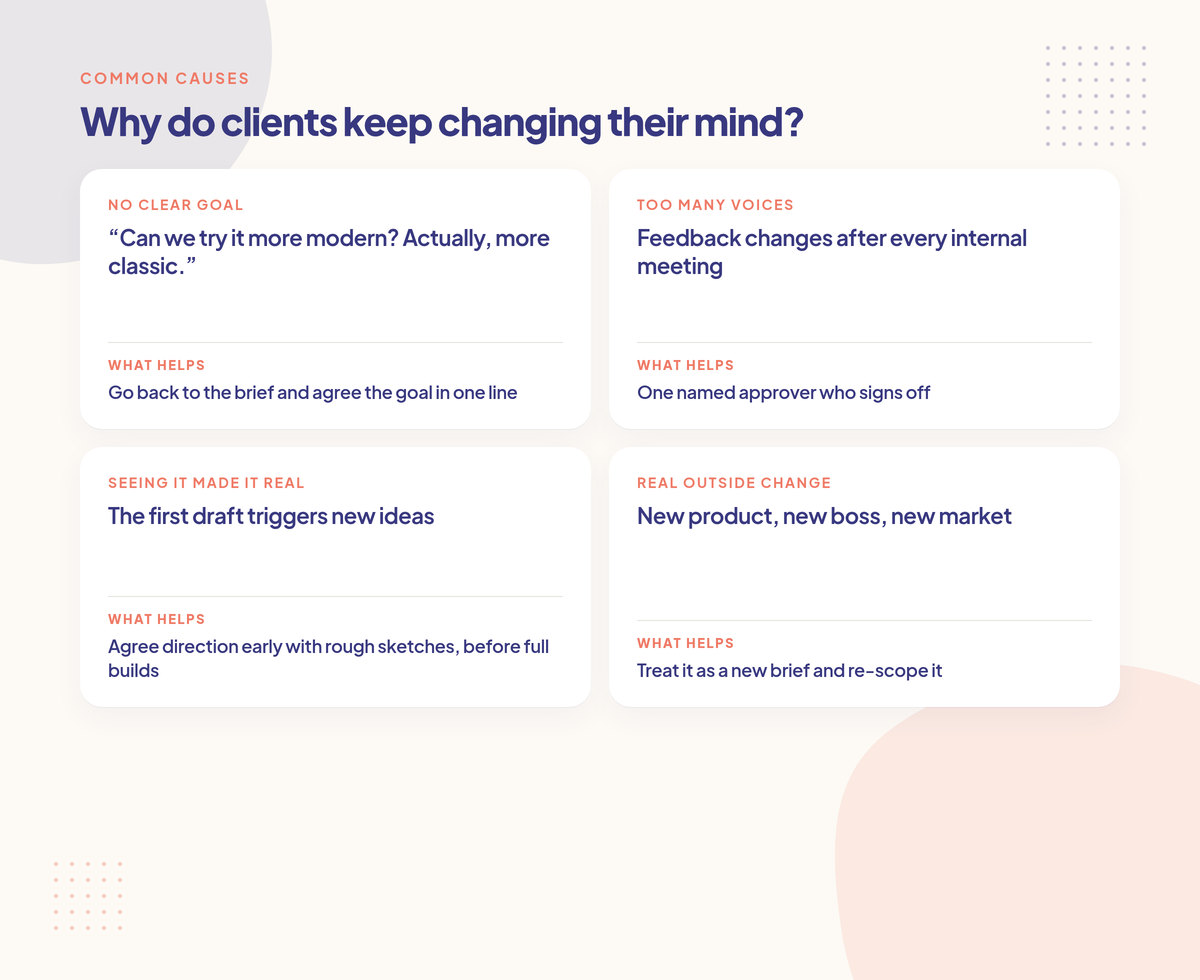
A few common causes, and what they point to:
What's happening | What it looks like | What helps |
|---|---|---|
No clear goal | "Can we try it more modern? Actually, more classic." | Go back to the brief and agree the goal in one line |
Too many voices | Feedback changes after every internal meeting | One named approver who signs off |
Seeing it made it real | The first draft triggers new ideas | Agree direction early with rough sketches, before full builds |
Real outside change | New product, new boss, new market | Treat it as a new brief and re-scope it |
The last one is fair. Businesses change, and a client who pivots because their market moved isn't being difficult. It still costs you time, though, so it still needs a new quote.
Is it a revision or a new direction?
A revision refines the thing you already agreed to make. A new direction replaces it. If the change keeps the same goal, audience and format, it's a revision. If it changes any of those, or throws out approved work, it's a new direction, and it should be quoted as new work instead of taking up a revision round.
This is the question that matters most. Get it right and most of the arguing goes away, because you're no longer debating whether the client is "allowed" to change their mind. They are. You're only deciding how the change gets handled.
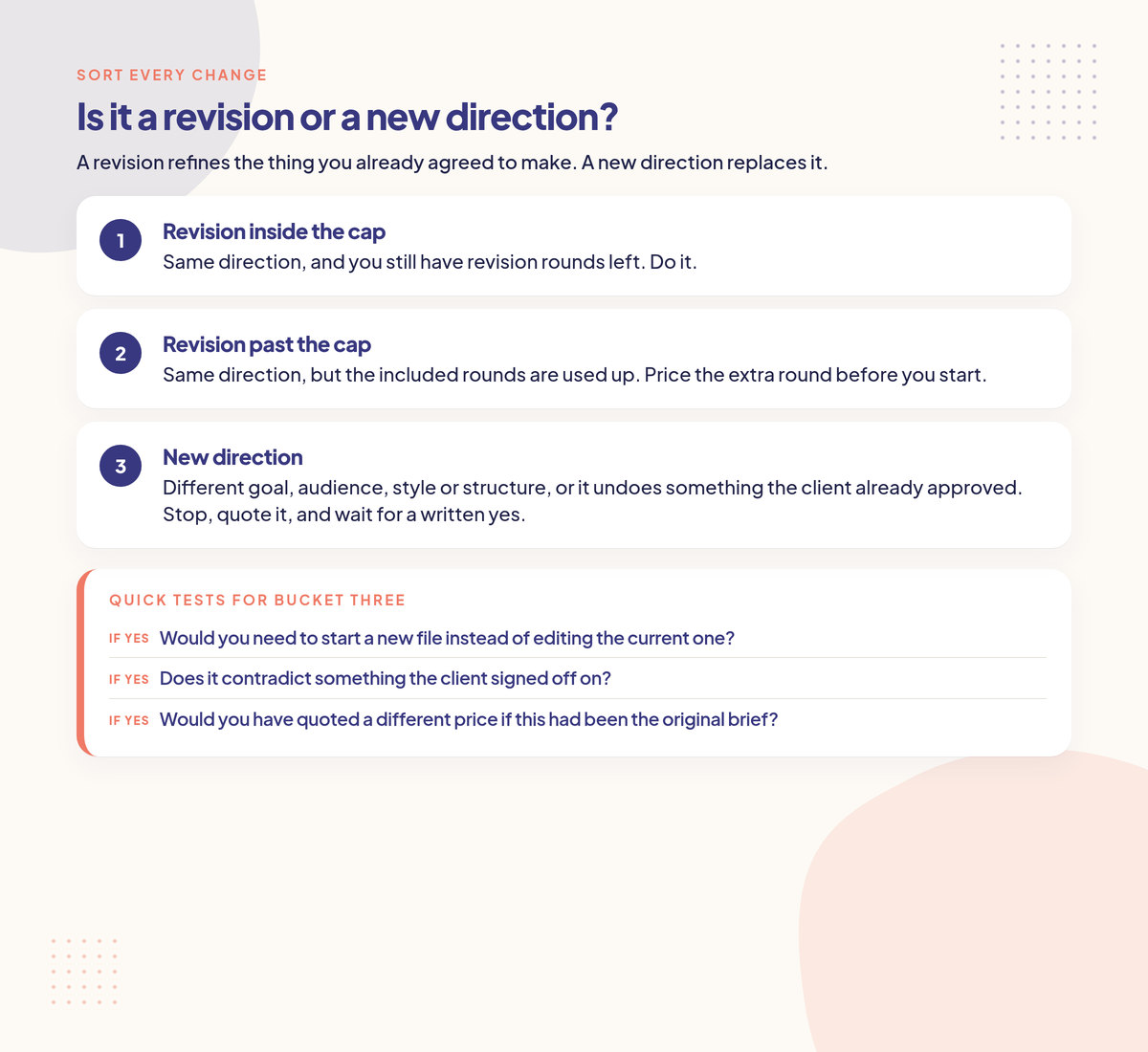
Run every change through three buckets:
Revision inside the cap. Same direction, and you still have revision rounds left. Do it.
Revision past the cap. Same direction, but the included rounds are used up. Price the extra round before you start. How to charge for extra revisions covers the numbers.
New direction. Different goal, audience, style or structure, or it undoes something the client already approved. Stop, quote it, and wait for a written yes.
Some quick tests for bucket three:
Would you need to start a new file instead of editing the current one?
Does it contradict something the client signed off on?
Would you have quoted a different price if this had been the original brief?
If the answer to any of these is yes, you're looking at a new direction.
How do you stop the same decision being reopened?
Write each decision down the moment it's made, and get the client to confirm it. A short "direction lock" message after each approval turns a chat into a record. When the client later wants to go back, you can point to what was agreed and treat the reversal as a change, not a misunderstanding.
The message doesn't need to be formal. Something like this, sent the same day:
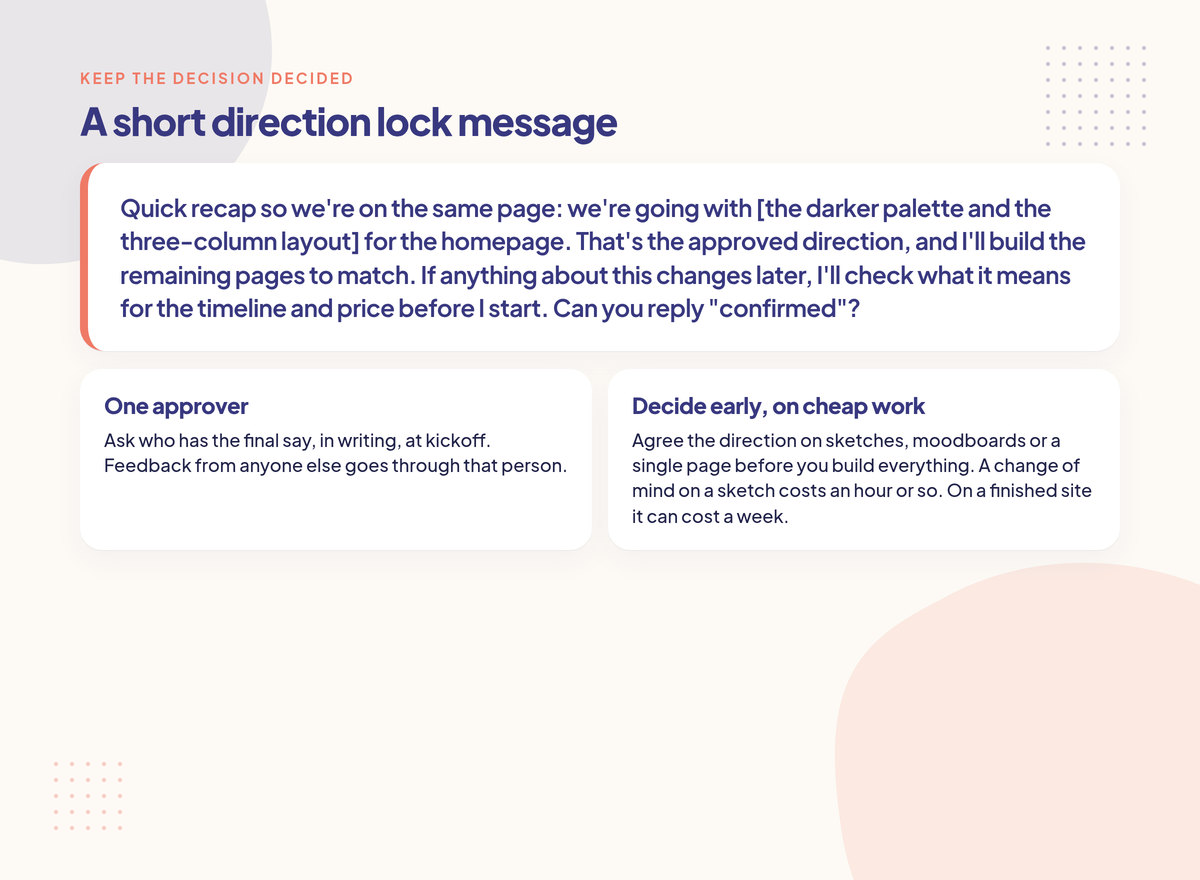
Quick recap so we're on the same page: we're going with [the darker palette and the three-column layout] for the homepage. That's the approved direction, and I'll build the remaining pages to match. If anything about this changes later, I'll check what it means for the timeline and price before I start. Can you reply "confirmed"?
Two more habits make this stick:
One approver. Ask who has the final say, in writing, at kickoff. Feedback from anyone else goes through that person.
Decide early, on cheap work. Agree the direction on sketches, moodboards or a single page before you build everything. A change of mind on a sketch costs an hour or so. On a finished site it can cost a week.
What do you say when the client changes direction again?
Acknowledge the idea, say which bucket it falls in, and give the client a choice. Keep it short and friendly. You're not refusing the change. You're showing what it costs before anyone commits, so the client can decide whether it's worth it.
Swap the brackets for your own details.
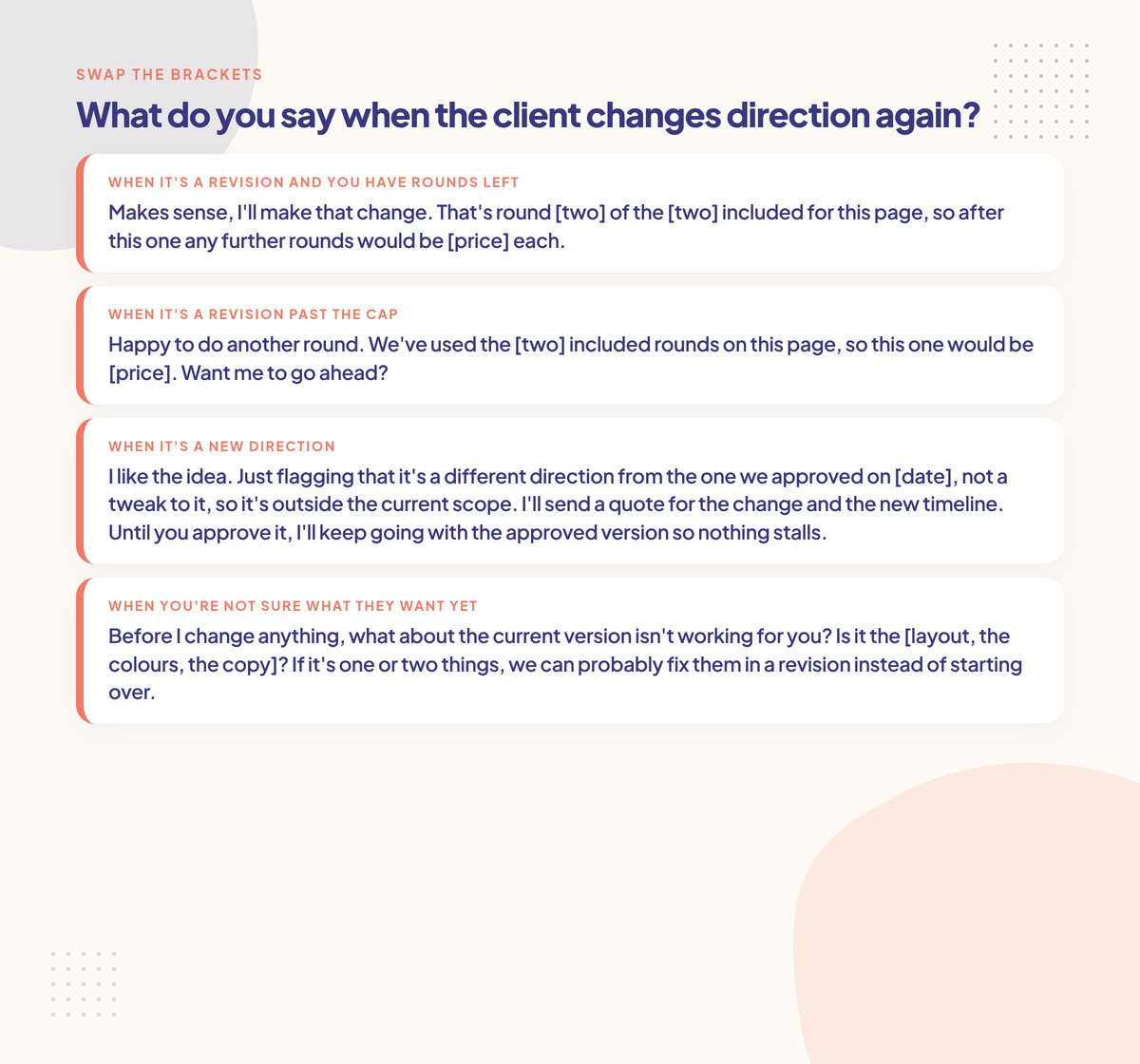
When it's a revision and you have rounds left:
Makes sense, I'll make that change. That's round [two] of the [two] included for this page, so after this one any further rounds would be [price] each.
When it's a revision past the cap:
Happy to do another round. We've used the [two] included rounds on this page, so this one would be [price]. Want me to go ahead?
When it's a new direction:
I like the idea. Just flagging that it's a different direction from the one we approved on [date], not a tweak to it, so it's outside the current scope. I'll send a quote for the change and the new timeline. Until you approve it, I'll keep going with the approved version so nothing stalls.
When you're not sure what they want yet:
Before I change anything, what about the current version isn't working for you? Is it the [layout, the colours, the copy]? If it's one or two things, we can probably fix them in a revision instead of starting over.
That last question saves a lot of restarts. A request to "redo the whole thing" is often a reaction to one part of it.
Should you charge for work already done on a dropped direction?
Yes, if the client approved that direction and then dropped it. The hours you spent are gone either way. Put the rule in your agreement before the project starts: approved work that's later replaced is still billed, and the new direction is quoted separately. Then point to it calmly when it comes up.
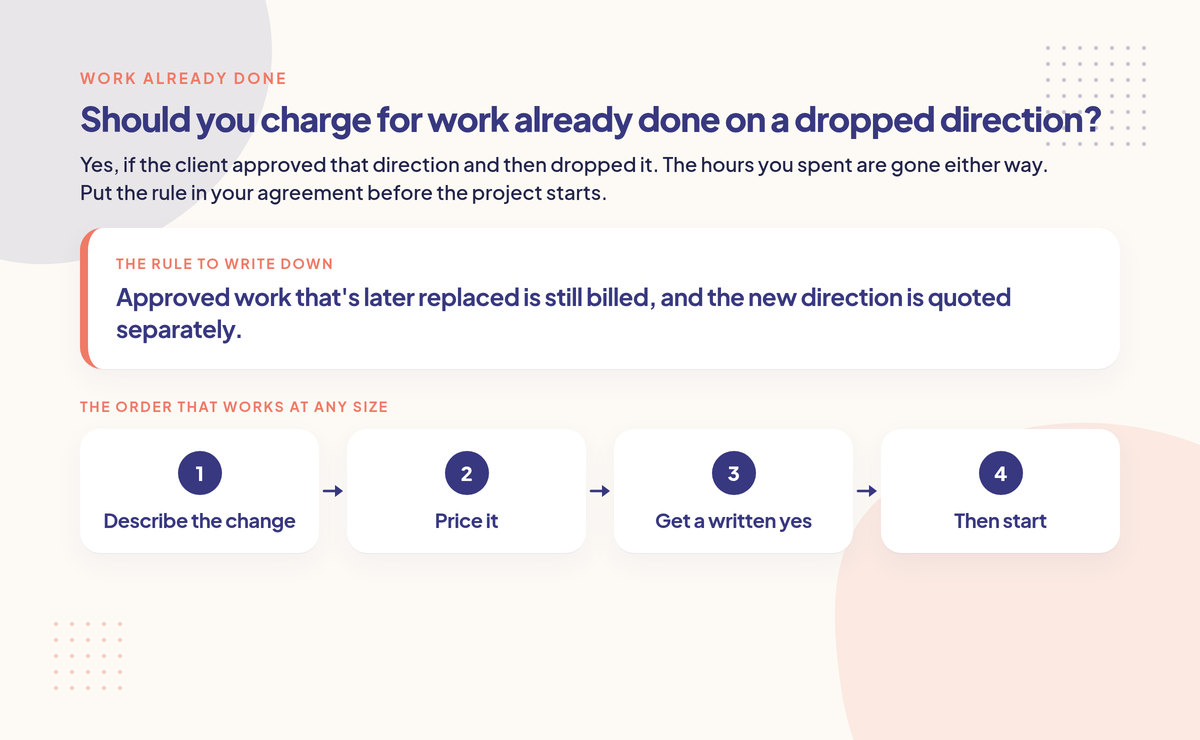
Bigger project teams already work this way. The Association for Project Management describes change control as capturing a change, evaluating it, and then approving, rejecting or deferring it before the agreed baseline moves. The Ontario Association of Architects tells its members not to proceed with changes without written authorization from the client, covering the change in services, the schedule and the fees. Neither is written for freelancers, but the order works at any size: describe the change, price it, get a written yes, then start.
This isn't only a small-studio problem either. PMI's 2018 Pulse of the Profession reported that 52% of projects completed in the previous 12 months had scope creep or uncontrolled changes (PMI, "Scope Patrol"). That's a survey of project professionals in larger organizations, so don't read it as a freelancer figure.
To work out the price of the new direction, use how to price a change request. It covers new work, rework and timeline impact. The change request form template gives you a page to put it on.
If changes arrive in five different places, it's hard to sort any of them. Creepless gives each client a private request link with no login, checks each ask against that client's scope rules (including revision limits), and marks it Included, Extra or Needs review. Extras become a quote the client approves before work starts.
Example (hypothetical)
A freelancer quotes $4,000 for a five-page website. The agreement includes two revision rounds per page and says a new direction after a design is approved is quoted as extra work, with no credit for the approved work it replaces. The rate is $100 an hour.
The client approves a light, minimal homepage design. The freelancer sends a direction lock message and the client replies "confirmed." Ten hours later, the homepage build is half done.
Then the client sees a competitor's site and asks for "something bold and dark, more like theirs." The freelancer runs the three tests. It's a new style, it contradicts the approved design, and it would need a new file. That's bucket three.
So the freelancer sends the "new direction" script and asks what the client likes about the other site. The answer: mostly the bold headline and the dark hero section.
That gives the client two options:
Option | What happens | Cost | Timeline |
|---|---|---|---|
A. Revision | Keep the approved design, add a dark hero and bigger headline as round one | Included | No change |
B. New direction | Restart the homepage in a dark style, then build the other pages to match | $1,200 extra (12 hours). The 10 hours already spent stay inside the $4,000 fee, not credited back | One extra week |
The client picks option A. The freelancer locks it in writing again and keeps building. If the client had picked B, work on the new style would have started only after a written yes on the $1,200 quote.
When is a client who keeps changing their mind a bad fit?
When the changes keep coming after you've set clear rules, sent quotes and had one honest conversation about it. At that point it's a fit problem, not a process problem. Some clients really can't decide, and you're paying for it in time. Reprice the work, move them to hourly billing, or plan an exit.
Before you get there, have the direct talk:
I want to get you a site you're happy with. We've changed direction [three] times now, and each restart pushes the launch back and adds cost. For the rest of the project, I'd like us to agree each direction in writing before I build it, and I'll quote any change to an approved direction first. Does that work for you?
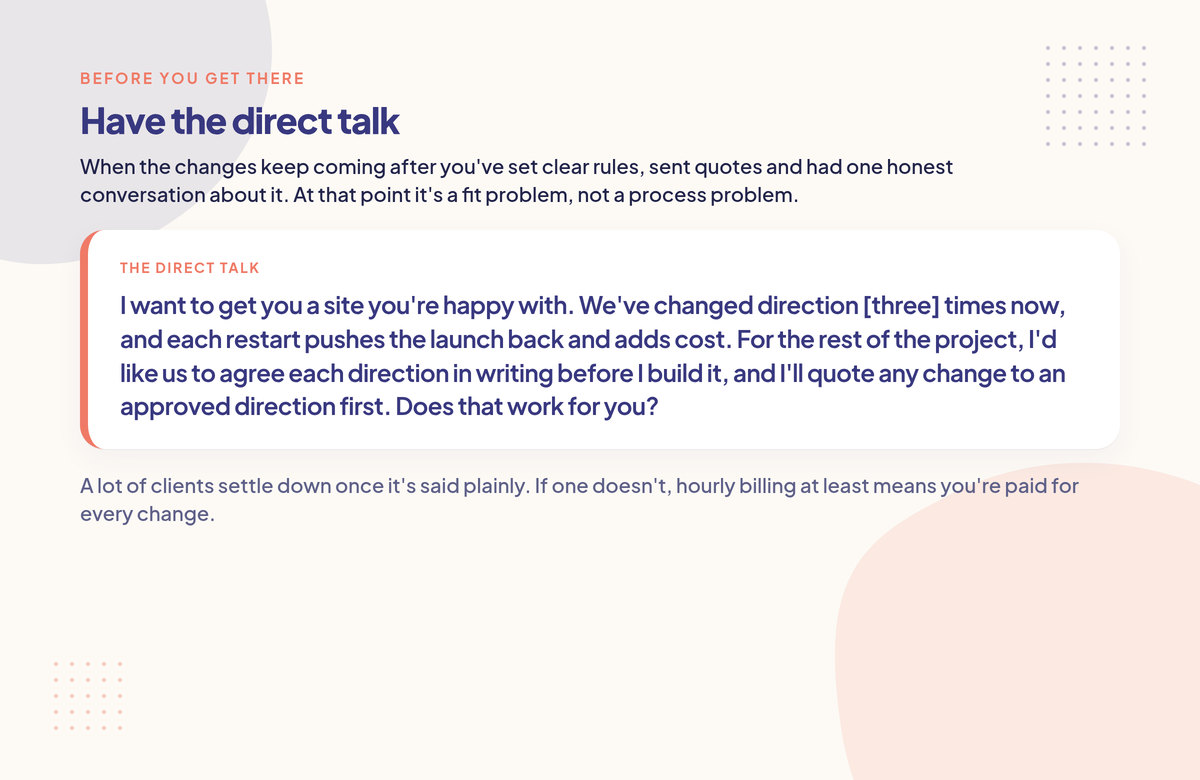
A lot of clients settle down once it's said plainly. If one doesn't, hourly billing at least means you're paid for every change.
FAQ
How do you deal with indecisive clients?
Narrow the choices. Show one recommended direction with a short reason, or two clear options, instead of an open "what do you think?" Agree the direction on cheap work like sketches first, write each decision down, and ask for one person with the final say.
What do you do when a client keeps changing requirements?
Sort each change: revision inside the cap, revision past the cap, or new requirement. Do the first, price the second, and quote the third with a new timeline before starting. Keep every request in one place so you can see the pattern.
Can you charge a client for changing their mind?
Yes, if your agreement says so. Include a set number of revision rounds, a price for extra rounds, and a rule that approved work replaced by a new direction is still billed. Tell the client the cost before you do the work, not on the invoice.
How many revisions should you include?
There's no standard number. Two rounds per deliverable is easy to explain and price, but pick what fits your work. What matters most is writing the number down and saying what counts as a round, so a third round or a new direction is clearly outside it.
The short version
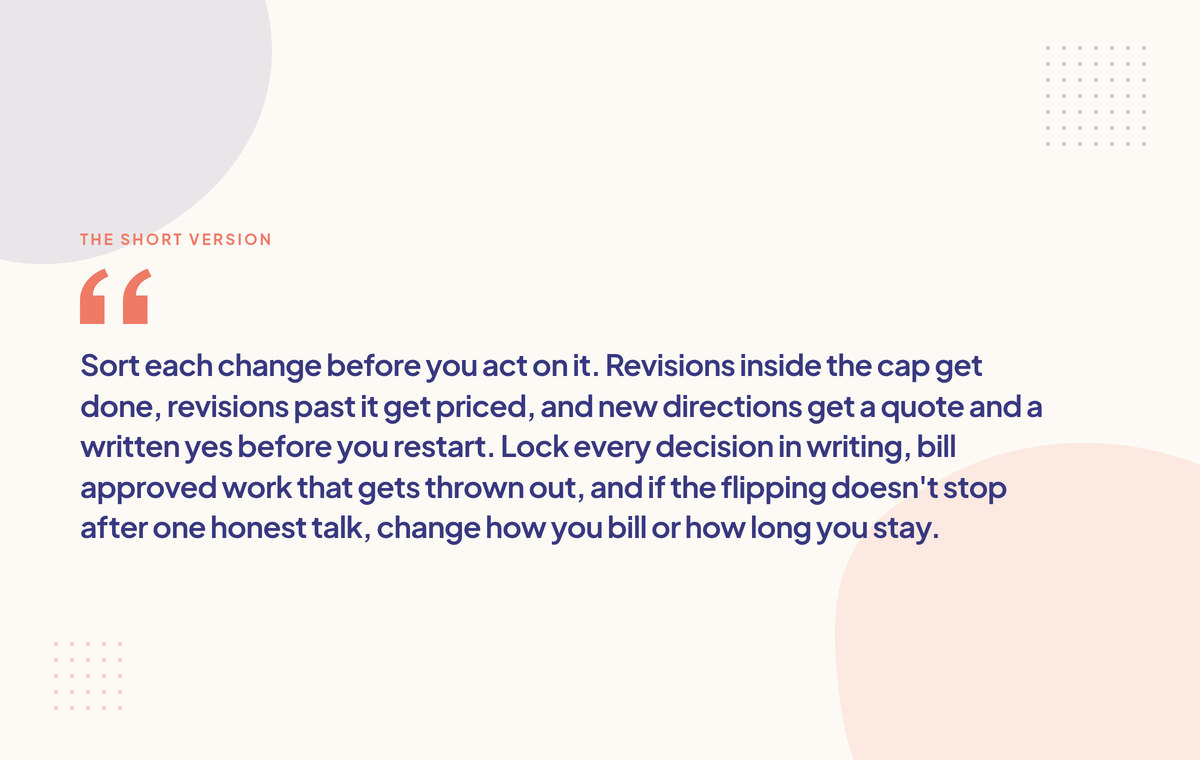
Sort each change before you act on it. Revisions inside the cap get done, revisions past it get priced, and new directions get a quote and a written yes before you restart. Lock every decision in writing, bill approved work that gets thrown out, and if the flipping doesn't stop after one honest talk, change how you bill or how long you stay.
Creepless checks every client request against the scope you agreed.