How to Set Boundaries with Demanding Clients: Scripts
Set response times, one request channel, revision and hour caps, and a quote-first rule for extras. Copy-paste scripts for freelancers and small agencies.

To set boundaries with demanding clients, write the rules down before the pressure starts: when you reply, where requests go, how many revisions and hours are included, and what happens to anything extra. Then hold them the same way every time, with a short, calm script.
What does a boundary with a client actually mean?
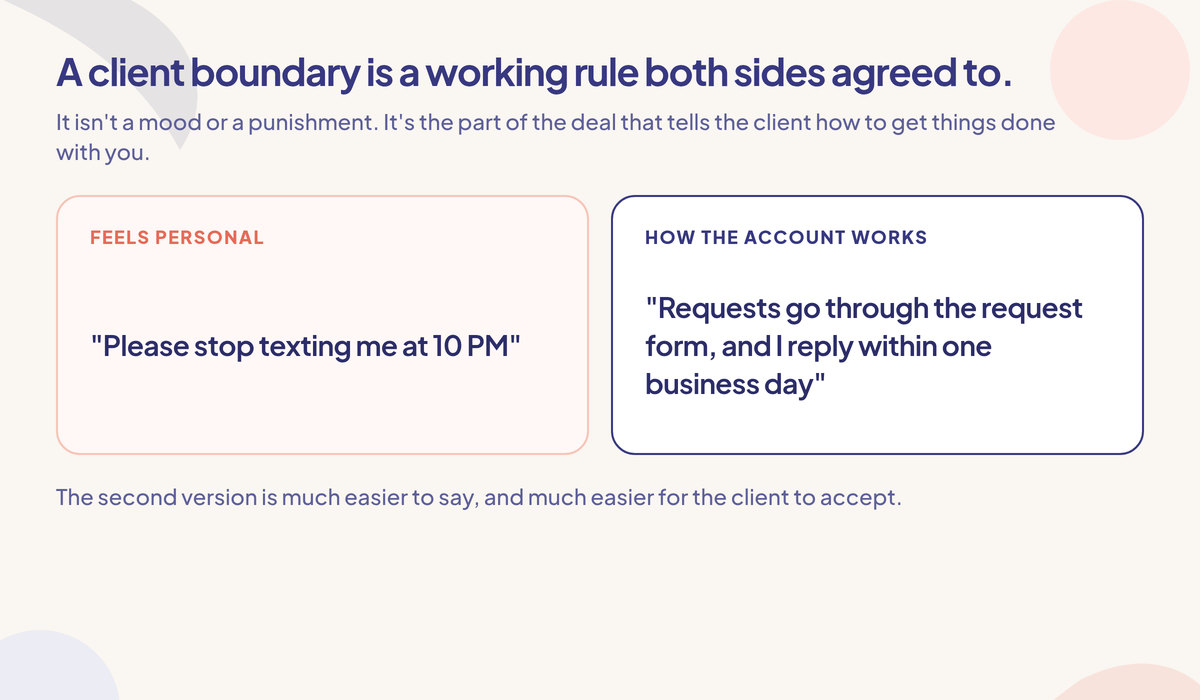
A client boundary is a working rule both sides agreed to, such as reply times, the channel for requests, the number of revision rounds, or the rule that extra work gets quoted first. It isn't a mood or a punishment. It's the part of the deal that tells the client how to get things done with you.
"Please stop texting me at 10 PM" feels personal. "Requests go through the request form, and I reply within one business day" is just how the account works. The second version is much easier to say, and much easier for the client to accept.
Demanding clients usually aren't trying to cross a line. They're busy, they're under pressure from their own boss, and nobody told them where the line is. If the line only exists in your head, you'll end up defending it one awkward message at a time.
Which boundaries should you set first?
Start with these four: response times, one request channel, revision and hour caps, and a quote-first rule for anything extra. Put all four in the proposal or scope of work, repeat them at kickoff, and keep them short enough that the client can remember them.
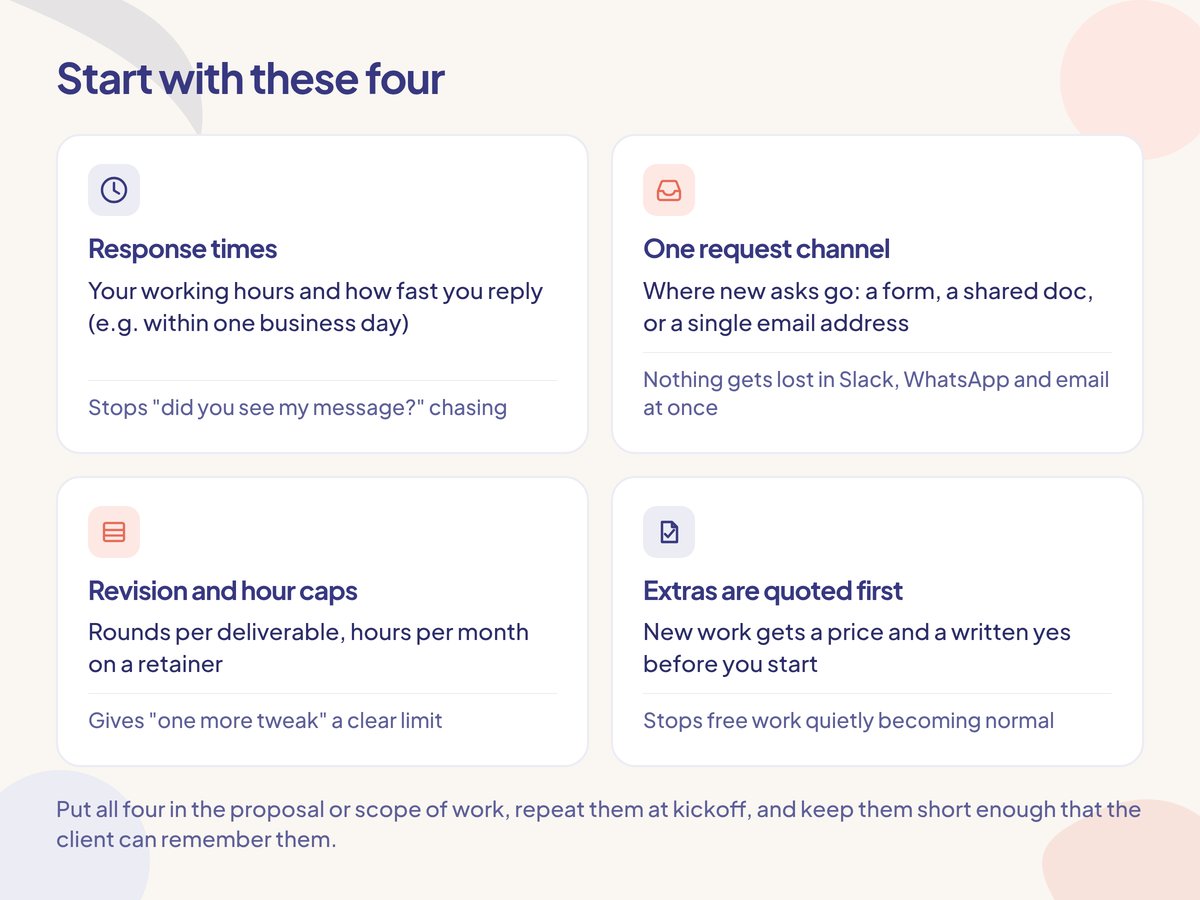
Boundary | What to write down | Why it helps |
|---|---|---|
Response times | Your working hours and how fast you reply (e.g. within one business day) | Stops "did you see my message?" chasing |
One request channel | Where new asks go: a form, a shared doc, or a single email address | Nothing gets lost in Slack, WhatsApp and email at once |
Revision and hour caps | Rounds per deliverable, hours per month on a retainer | Gives "one more tweak" a clear limit |
Extras are quoted first | New work gets a price and a written yes before you start | Stops free work quietly becoming normal |
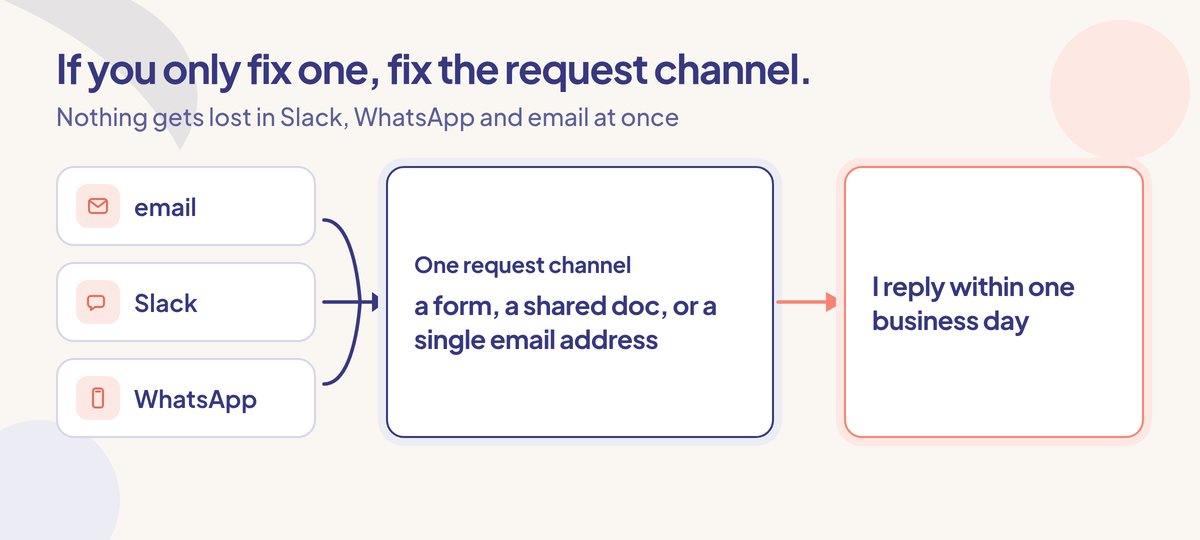
If you only fix one, fix the request channel. Most of the other problems get easier once every ask lands in the same place.
The scope of work template has room for inclusions, exclusions and revision rounds, so you can write these down in one go.
How do you set boundaries without losing the client?
Set them early and explain them as process, not as a reaction to something the client did. A boundary introduced at kickoff sounds normal. The same boundary introduced after a bad week sounds like a complaint. Keep the tone friendly, give the reason in one line, and always offer the client a way to get what they need.
That last part is the big one. A boundary that only says "no" feels like a wall. A boundary that says "here's how" feels like service:
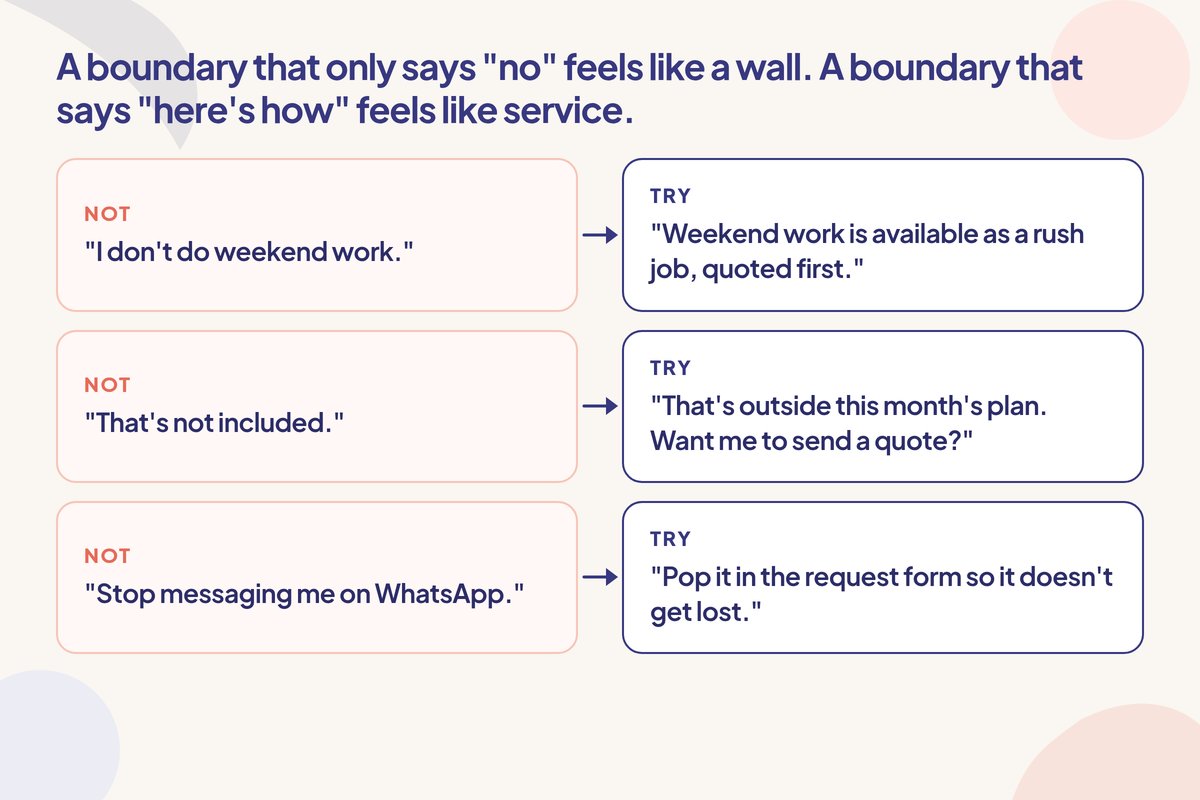
Not "I don't do weekend work." Try "Weekend work is available as a rush job, quoted first."
Not "That's not included." Try "That's outside this month's plan. Want me to send a quote?"
Not "Stop messaging me on WhatsApp." Try "Pop it in the request form so it doesn't get lost."
What do you say when a client crosses a line?
Name the rule, offer the route, and don't over-explain. Keep the message short and calm, and send it soon after the first crossing, not after the fifth. Here are scripts for the most common moments. Swap the brackets for your own details.
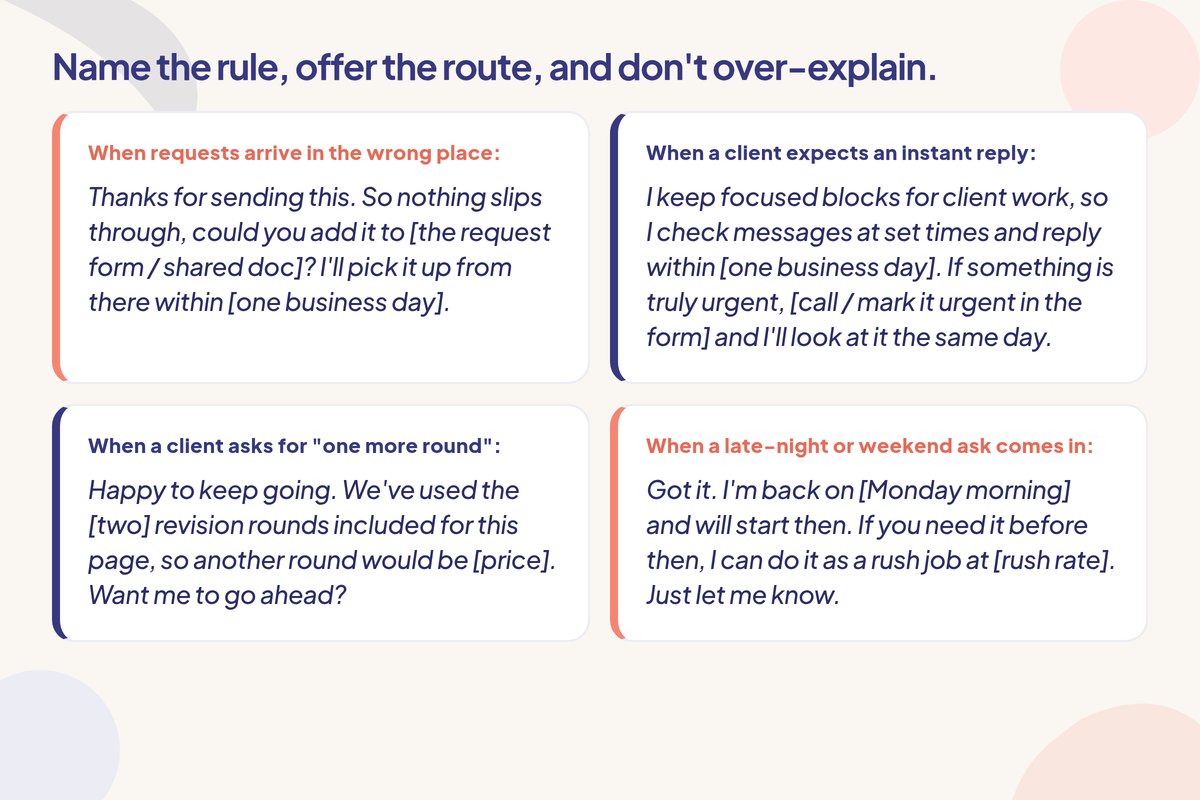
When requests arrive in the wrong place:
Thanks for sending this. So nothing slips through, could you add it to [the request form / shared doc]? I'll pick it up from there within [one business day].
When a client expects an instant reply:
I keep focused blocks for client work, so I check messages at set times and reply within [one business day]. If something is truly urgent, [call / mark it urgent in the form] and I'll look at it the same day.
When a client asks for "one more round":
Happy to keep going. We've used the [two] revision rounds included for this page, so another round would be [price]. Want me to go ahead?
When a late-night or weekend ask comes in:
Got it. I'm back on [Monday morning] and will start then. If you need it before then, I can do it as a rush job at [rush rate]. Just let me know.
When a request is new work, not a change:
That's a new piece of work rather than a tweak to what we agreed, so I'll send you a quote first. Once you approve it, I'll schedule it in.
For more wording on out-of-scope asks specifically, the out-of-scope scripts post has longer versions.
How do you stop extra requests turning into free work?
Make every new ask go through one written route, decide whether it's included before you start, and get a written yes on the price for anything extra. Then do the work. The order matters more than the wording. Once you've done the work, you're asking to be paid. Before you start, you're just agreeing a price.
Larger project teams have a name for this: change control. The Association for Project Management describes it as capturing a change, evaluating it, and then approving, rejecting or deferring it before the agreed baseline moves. The UK government's Teal Book guidance says changes should only be implemented through a structured process, after an impact assessment. Both are written for big projects, not two-person studios, but the order works at any size.
PMI's 2018 Pulse of the Profession reported that 52% of projects completed in the prior 12 months had scope creep or uncontrolled changes (PMI, "Scope Patrol"). That survey was of project professionals in larger organizations, so don't read it as a freelancer figure. It does show the problem isn't unique to small studios with pushy clients.
A simple version of the route:
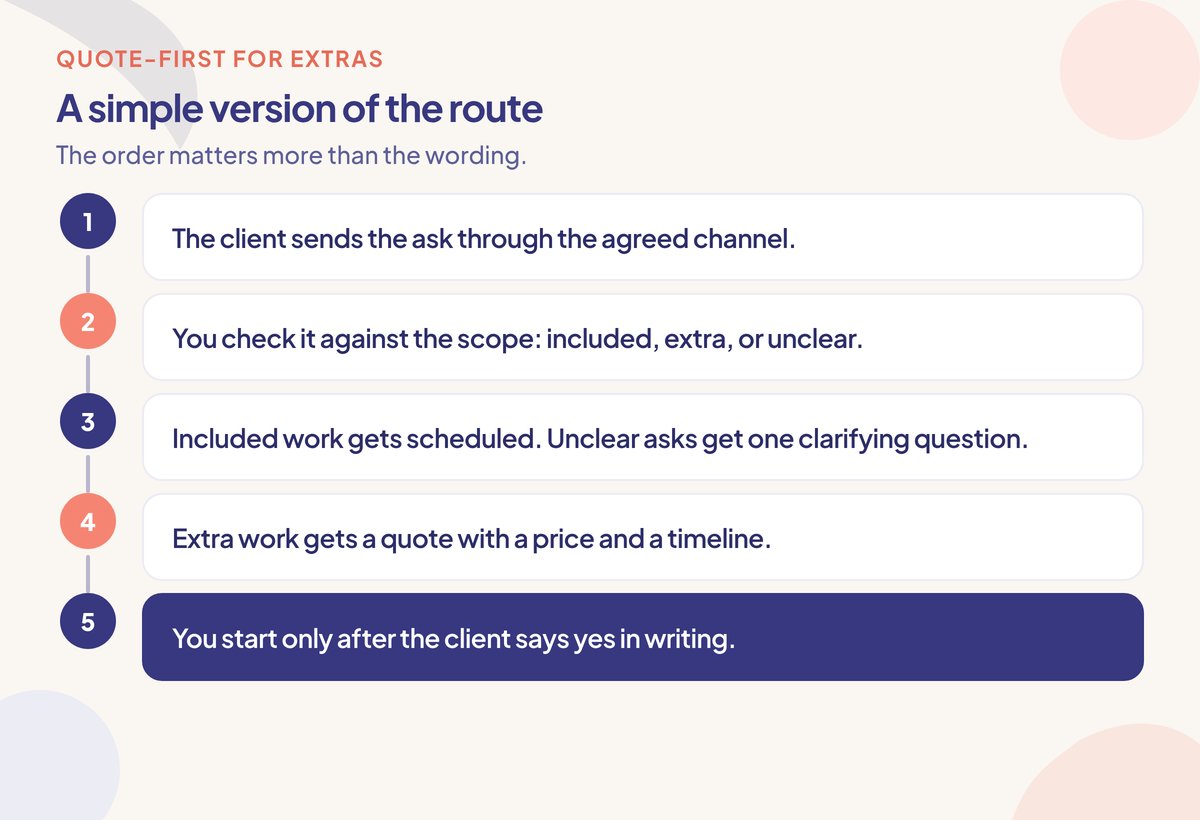
The client sends the ask through the agreed channel.
You check it against the scope: included, extra, or unclear.
Included work gets scheduled. Unclear asks get one clarifying question.
Extra work gets a quote with a price and a timeline.
You start only after the client says yes in writing.
If you'd rather not sort every ask by hand, Creepless gives each client a private request link with no login. It checks each ask against that client's rules and marks it Included, Extra or Needs review. You can override any call it makes, and extras become a quote the client approves before work starts.
For pricing the extras themselves, how to charge for extra revisions and how much to charge for a rush fee cover the numbers.
Example (hypothetical)
A two-person studio runs a $2,000 monthly website retainer with up to 20 hours of updates. The agreement says requests go through a shared form, replies come within one business day, and anything beyond 20 hours or outside the listed tasks gets quoted first.
In week one, the client sends three asks by WhatsApp, one by email and one on a call. The studio replies to each with the "wrong place" script and adds them to the form itself the first time, so nothing is lost.
In week two, the client asks for a new landing page on a Friday evening and wants it Monday. The studio answers on Monday morning: a new page isn't in the retainer list, so it's a quote of $600, or $750 with a rush fee for a Wednesday delivery. The client approves the $600 version for the following week.
By week three, most asks are coming through the form, because that's now the quickest way for the client to get things done.
What if the client keeps ignoring your boundaries?
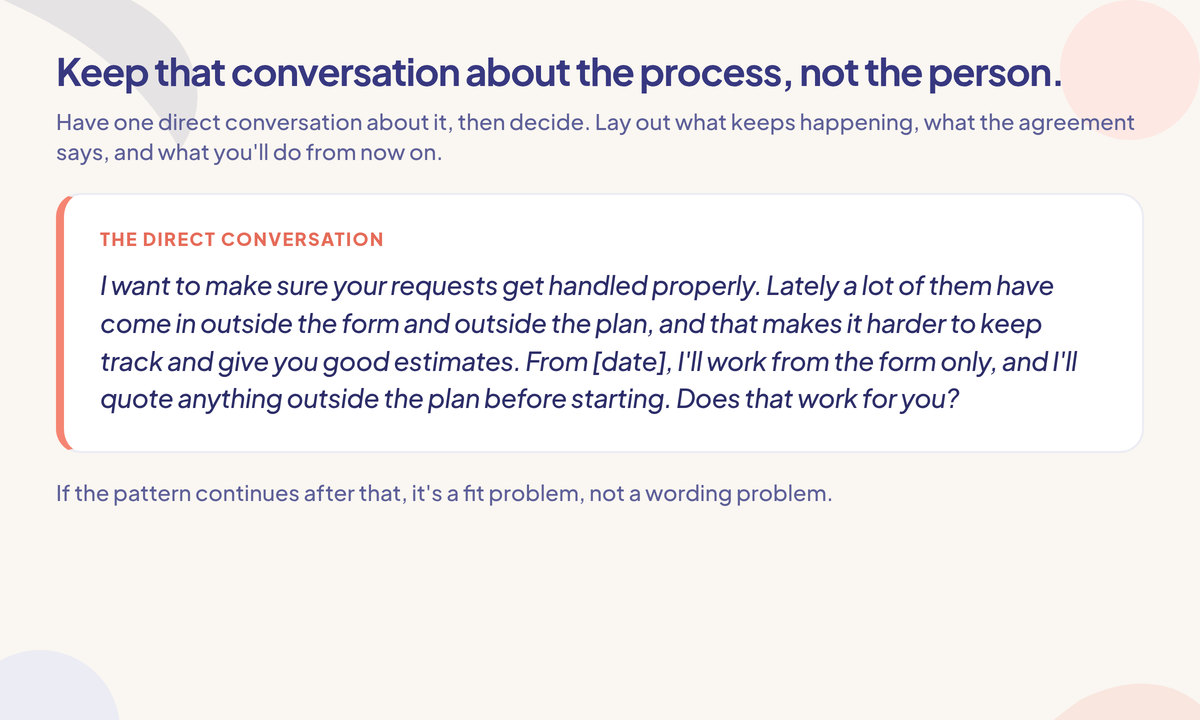
Have one direct conversation about it, then decide. Lay out what keeps happening, what the agreement says, and what you'll do from now on. If the pattern continues after that, it's a fit problem, not a wording problem, and it's fair to reprice the work or plan an exit.
Keep that conversation about the process, not the person:
I want to make sure your requests get handled properly. Lately a lot of them have come in outside the form and outside the plan, and that makes it harder to keep track and give you good estimates. From [date], I'll work from the form only, and I'll quote anything outside the plan before starting. Does that work for you?
A lot of clients adjust once it's said plainly. Some won't. If a client still expects unlimited work at a fixed fee after a clear talk, no script will fix that.
FAQ
How do you set professional boundaries with clients?
Write them into the proposal or scope of work: reply times, the request channel, revision and hour caps, and the rule that extras get quoted first. Repeat them at kickoff. When a client crosses one, name the rule and offer the route in a short, friendly message.
How do you deal with a demanding client?
Give them a clear way to get things done. Most demanding clients want speed and certainty, so set reply times they can rely on, one place to send requests, and quick quotes for extras. Then apply the same rules every time, so they know what to expect.
Is it unprofessional to say no to a client?
No. Saying no to unpaid or out-of-hours work is part of running a business. It helps to say "not like that, but here's how." Offer a quote, a later date or a rush option instead of a flat no.
How do I stop clients messaging me after hours?
Put your working hours and reply time in the agreement and your email signature. Don't reply to late messages until your next working block, unless you've agreed a paid rush option. If you reply at 11 PM, the client will fairly assume 11 PM is fine.
The short version
Write four rules down before the project starts: reply times, one request channel, revision and hour caps, and quote-first for extras. Hold them with short scripts that point to the route instead of just saying no. If a client keeps ignoring them after one honest conversation, reprice the work or plan an exit.
Creepless checks every client request against the scope you agreed.