Quote for Additional Work: What to Include + Template
A quote for additional work should state the extra work, price type, new dates, payment terms and expiry. Learn what to include and copy the template.
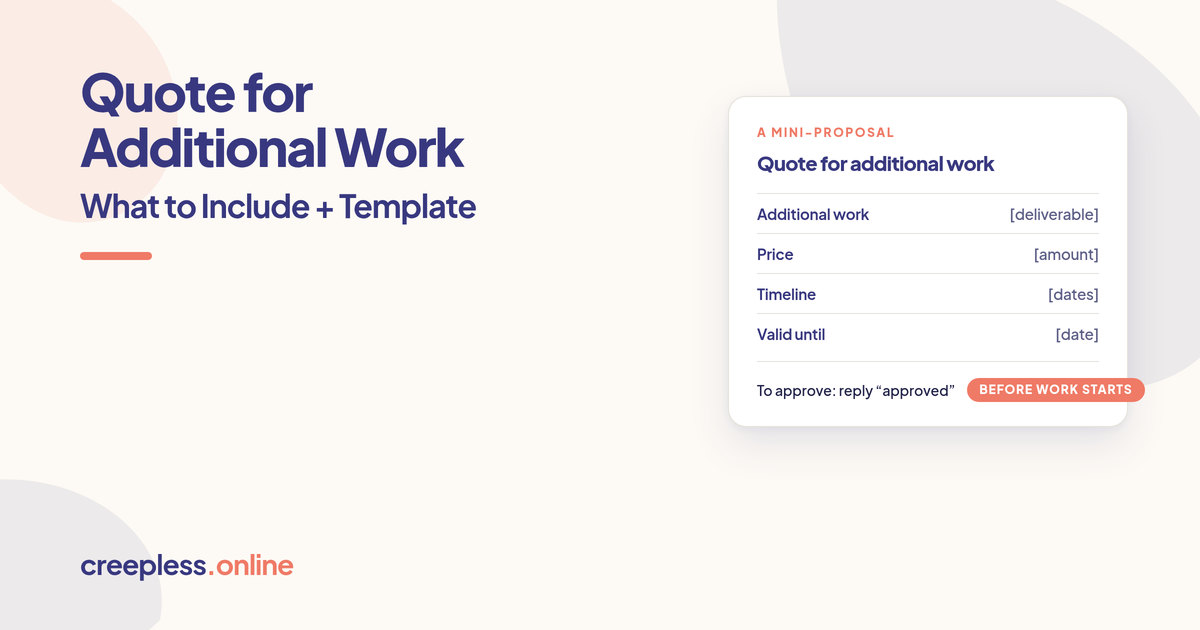
A quote for additional work is a short, written offer for work that sits outside the scope you already agreed. It names the extra work, says whether the price is fixed or an estimate, shows what happens to the timeline, sets payment terms and an expiry date, and asks for a clear yes before anything starts.
Most freelancers and agencies get the price roughly right and the paperwork wrong. The number goes out in a chat message, nobody says when it expires, and the "yes" turns out to be a thumbs-up from someone who can't approve spending. This post is about the quote document itself: which type of price to give, the fields to include, validity, deposits, approval, and a copy-paste template. To work out the number, use how to price a change request. For the wording of the message, use the 8 out-of-scope scripts.
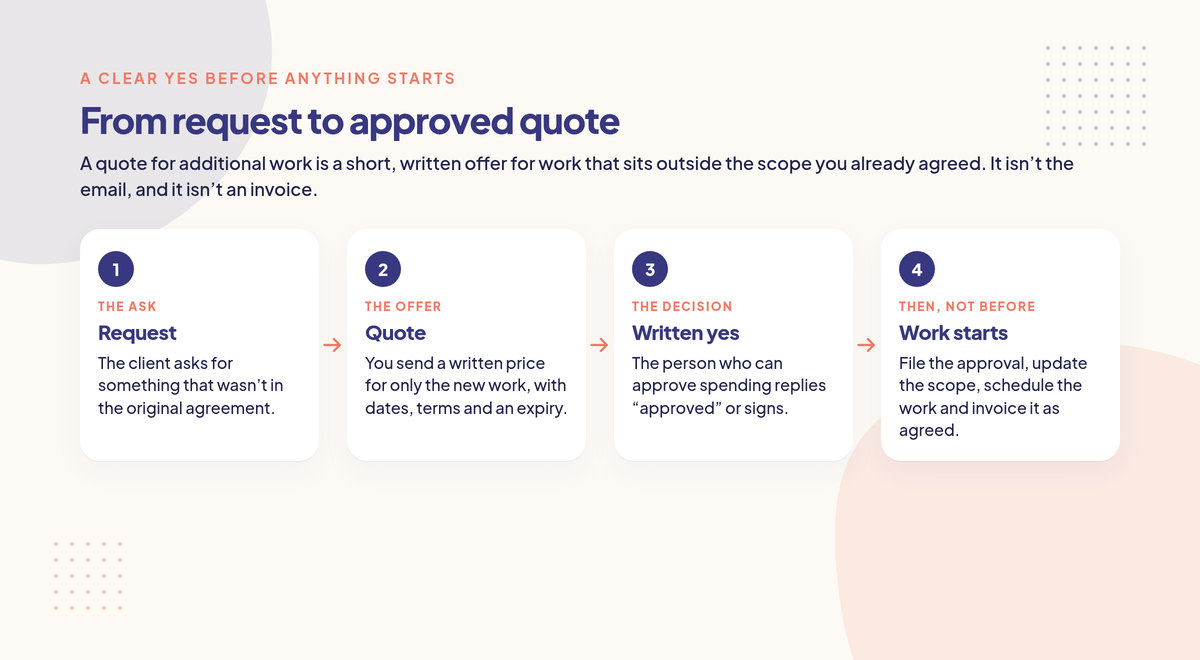
A quote isn't the email, and it isn't an invoice. Nothing starts until the written yes is back.
What is a quote for additional work?
A quote for additional work is a written price for a specific piece of work that wasn't in the original agreement. It refers back to that agreement, describes only the new work, and says what it costs, how it moves dates and how the client approves it. Once accepted, it becomes part of the project's paper trail.
You'll also see it called an out-of-scope quote, an additional work quotation, an add-on quote or a variation. In agency work it often becomes the change order once approved, or simply is the change order.
For how a request like this differs from plain scope creep, see scope creep vs scope change.
AIGA's long-running guide to design proposals describes a change order as a document the designer drafts "to acknowledge a client request that is outside of the original scope for the project." It states the extra time and money, goes to the client "for review and an authorized signature," and is "essentially a mini-proposal." The guide also says to reference the original proposal and state that the same terms and conditions apply.
That's the right way to think about any quote for extra work: a mini-proposal with one job, which is getting a clear decision on one addition without reopening the whole contract. It isn't the email (that's the cover note), and it isn't an invoice (that comes after the work). If you're still deciding whether a request is extra in the first place, start with the what is scope creep guide and your written scope.
Quote, estimate or change order: which should you send?
Send a quote (a fixed price) when you can describe the extra work clearly enough to price it. Send an estimate, ideally a range with a cap, when you can't yet. Use a change order when the contract asks for one or the addition is big enough to need a signature. All three need a written yes before work starts.
The words get used loosely, but government guidance is consistent on the main difference. Business Queensland's guide to preparing a business quote calls an estimate "your rough guide to how much something will cost" and says that, unlike quotes, estimates "are not legally binding." Citizens Advice puts the customer's view simply in its guide to getting work done on your home: "A quote is a fixed price... An estimate is just a rough guess, so you might end up paying more."
Those guides are written for Australia and England and for trades work, so read them as a picture of how clients understand the words, not as legal advice. The point carries over: clients read "quote" as "this is what I'll pay." If you're not sure of the number, don't call it a quote.
Price type | What the client sees | Use it when | Watch out for |
|---|---|---|---|
Fixed quote | One price for a defined addition | You can list exactly what's being added | Vague descriptions. If the work grows, you carry it |
Estimate range with a cap | "Between X and Y, and we won't pass Y without asking" | The work is real but has unknowns (an integration, a migration) | A range so wide it says nothing |
Hourly with a not-to-exceed limit | Rate, expected hours and a ceiling | Small, open-ended tasks billed on time | Report hours as you go so the ceiling isn't a surprise |
Scope swap ($0) | "We'll add this and drop that, same price and date" | Budget is fixed and something in the plan matters less | Not writing down what was dropped |
Phase two | A separate quote for later | The addition is big or not urgent | Leaving it unpriced "for later" with no date |
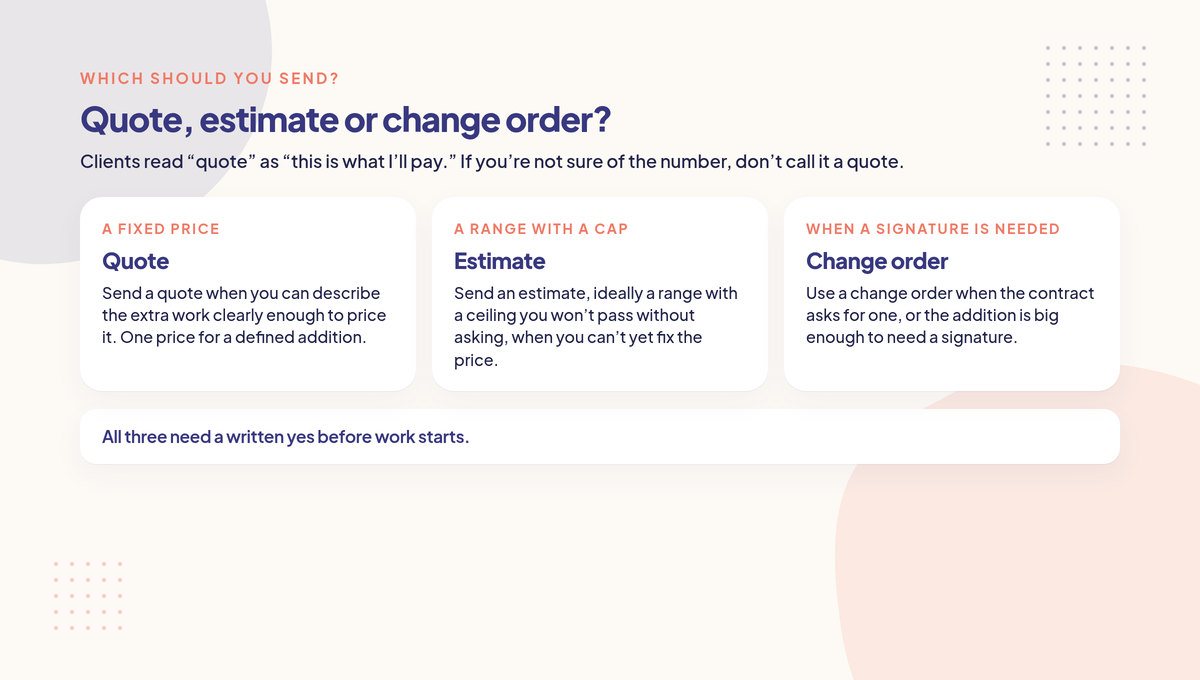
Clients read "quote" as "this is what I'll pay." If you're not sure of the number, don't call it a quote.
Should you quote a fixed price or an estimate range?
Quote a fixed price when the extra work is clear and similar to things you've done before, like one more page or one more round. Give an estimate range with a cap when there's a real unknown you can't remove by asking a question. If you can't estimate at all, quote a small paid step to find out first.
A quick test: could someone else on your team read your description and agree on what "done" means? If yes, fix the price. If not, you have two moves.
Ask one more question. Often a request is vague rather than uncertain. "Can you add booking?" could mean a link to a calendar app or a custom system. The out-of-scope email writer page makes the same point: if a request is unclear, ask what the finished result should look like before quoting anything.
Or quote the unknown separately. Price a short, fixed piece of investigation (an audit or a test), then quote the build once you know more. NT.GOV.AU's consumer page on quotes and estimates notes that charging for a quote can be legitimate when preparing it means pulling something apart to test it, and that the fee is often taken off the final amount. The same logic sits behind paid discovery, which should you charge for a discovery phase covers.
If you do give a range, keep it tight enough to approve, say what would push it to the top end, add a ceiling you won't pass without new written approval, and say when you'll confirm a fixed figure. The NT page advises customers working from an estimate to ask for a call once the full extent is known and to set a limit.
What should a quotation for additional work include?
A quotation for additional work should include a quote number, a reference to the original agreement, a specific description of the added work, what's not included, assumptions, the price type and amount, tax, the timeline impact, payment terms, an expiry date, and one clear line saying how the client approves it.
That lines up with government quoting guides. business.gov.au says a written quote should include at least a clear description of the work, itemised and total costs, payment terms, start and finish dates, a quote expiry date, and space for the customer's acceptance, on its page about how to prepare quotes. Citizens Advice adds two lines that matter for extras: how long the price is valid for, and "when the price can go up."
What each field does on an extra work quote:
Quote number and date. Give each quote its own number (Q-07 for the seventh extra on a project). It makes the approval easy to find and easy to reference on the invoice.
Reference to the original agreement. Name the proposal, contract or scope of work this sits on, and say its terms still apply unless the quote changes them.
What's being added. Describe the output, not the effort. "One additional landing page using the approved design, with one revision round" is checkable. "Landing page work" isn't.
What's not included. One or two lines on nearby things the client might assume come with it, such as copywriting or new photos. The project exclusions generator can help with phrasing.
Assumptions and client inputs. What the price depends on: content by a date, system access, one person giving feedback.
Price type and amount. Fixed, range with a cap, or hourly with a ceiling, plus the currency.
Tax. Included or excluded. "Should a quote include VAT" and "should a quote include GST" are both Google suggestions for a reason.
Timeline impact. Original date, new date, and whether in-progress work is affected.
Payment terms. When it's invoiced, when it's due, and anything due before work starts.
Valid until. The date the offer expires.
How to approve, and who. The exact action and the person who can approve spending.
Revision rounds on the new work. Say how many, so the extra doesn't come with unlimited changes. How to charge for extra revisions explains how to define a round.
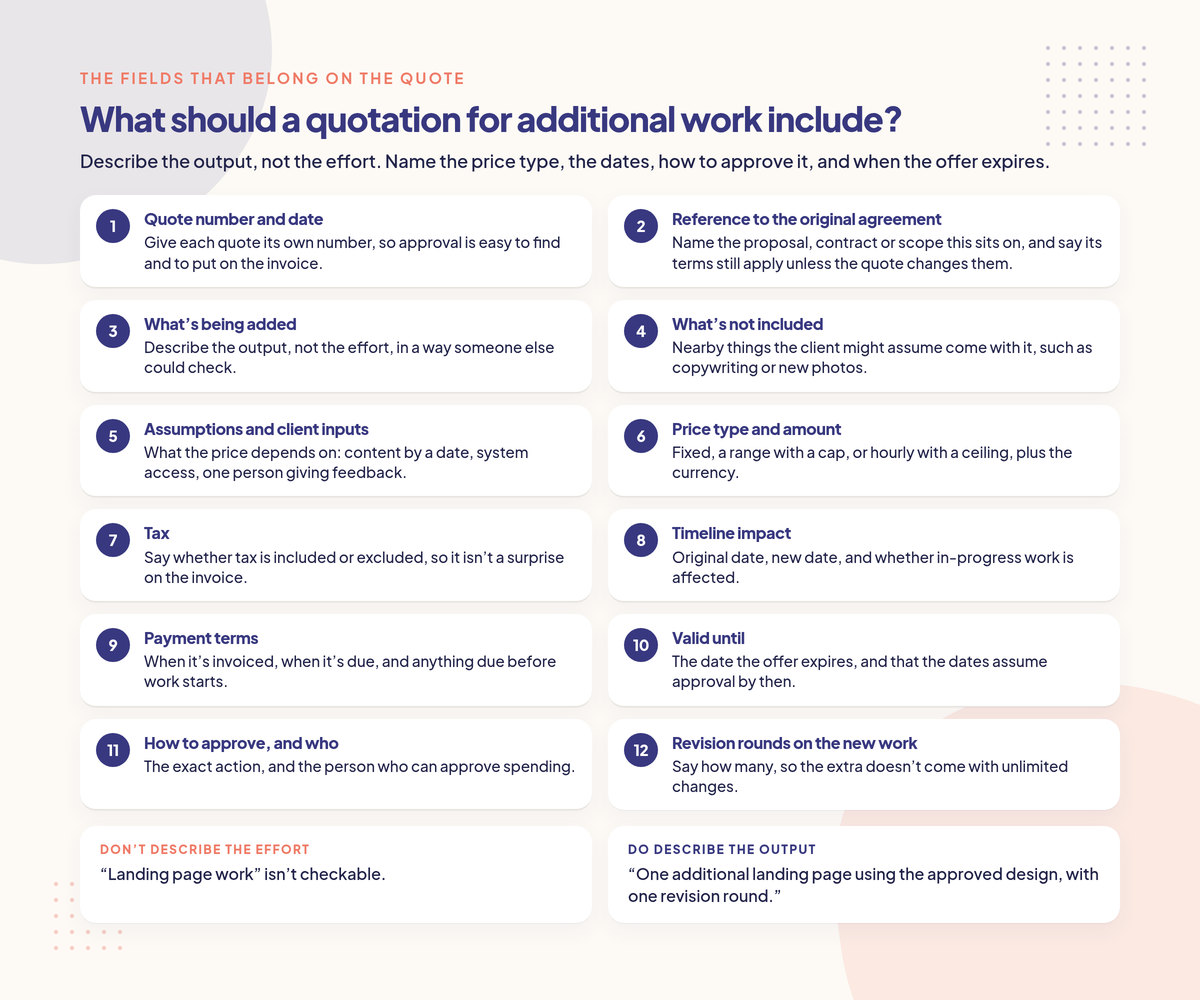
Describe the output, not the effort. Name the price type, the dates, how to approve it, and when the offer expires.
How long should a quote for additional work be valid?
There's no standard validity period, so pick one that matches how fast your schedule fills. Mid-project extras usually deserve a short window, days or a couple of weeks, because the dates you promise depend on when the client says yes. Whatever you pick, print the expiry date on the quote and tie your dates to it.
None of the guides sets a single correct number. What they agree on is that the date should be there. Business Queensland is blunt: "without an expiry date, you may have to honour a quote that will lose you money." AIGA says to state how long an unsigned offer stays valid, because if the client sits on it for a month or two you may need to update it for changes in your pricing or availability.
On a live project, availability is usually the bigger issue. "Adds three working days" is only true if the client approves while those days are still free. So link the two:
Valid until [date]. The timeline above assumes approval by then. After that, I'll confirm new dates before starting.
If a quote expires and the client still wants the work, send a fresh one with a new number and date rather than editing the old one, even if the price hasn't changed. NT.GOV.AU suggests the same check from the customer's side: after expiry, see whether the quote needs amending. One short nudge a day or two before expiry is usually enough.
Should you ask for a deposit or upfront payment for extra work?
For small extras, adding the amount to the next invoice is usually enough. For larger additions, or extras that are really a new mini-project, asking for part of the price upfront is reasonable and common in some industries. Whatever you choose, write it on the quote so payment isn't a separate argument later.
The usual options, roughly by size:
Add it to the next scheduled invoice. Fine for small additions from clients who pay on time.
Invoice on completion of the extra. AIGA says "each change order should be invoiced separately" as the work is completed. A separate invoice that references the quote number is easy to trace.
Part upfront, part on completion. Business Queensland notes that in some industries it's common to ask for half up front, which helps cash flow. Fair for a large addition, especially if you're buying assets or booking a contractor.
Full payment before work. Sensible for one-off extras after a project has wrapped, or for clients who pay late.
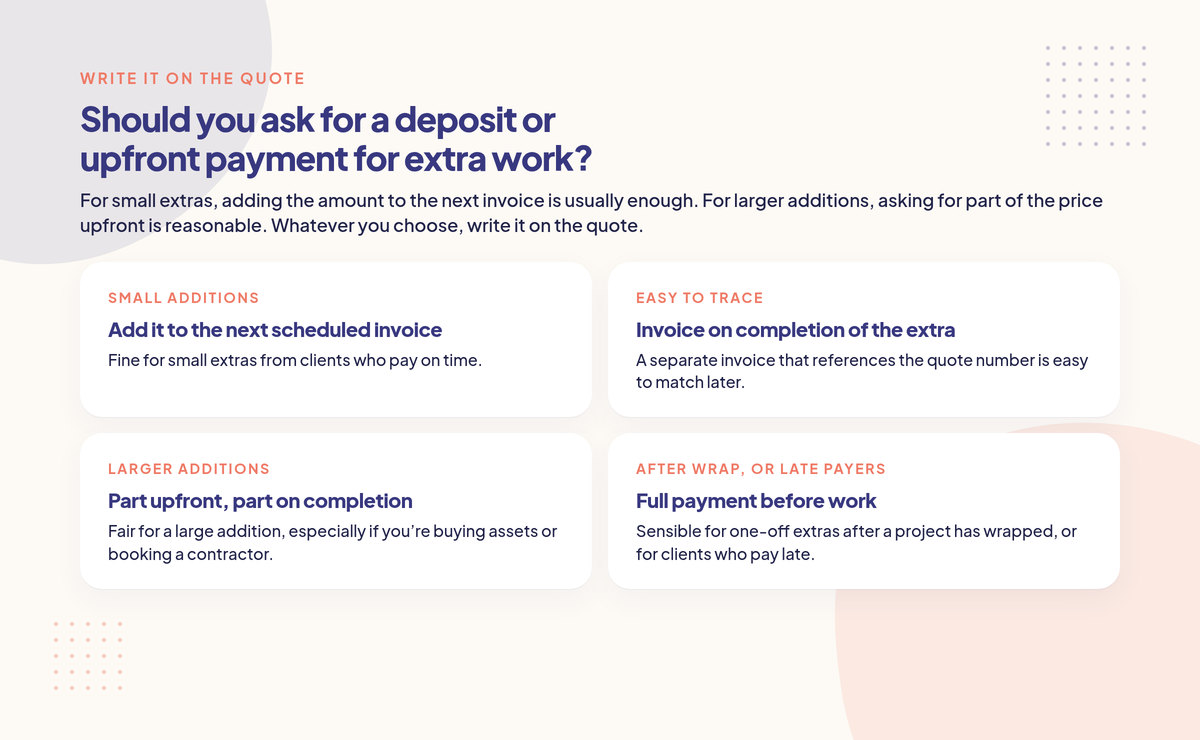
Whatever you choose, write the payment terms on the quote so they aren't a separate argument later.
If your original contract already covers deposits and payment terms, the quote can say "payment terms as in our agreement dated [date]" plus anything that differs. Clients on a retainer are different again, because extras usually get billed as overages; see how to handle extra work on a retainer and how to bill retainer overages. And if a deposit is due before work starts, put it in the approval line, so saying yes and paying are clearly linked.
How do you show timeline impact on the quote?
Show the original date, the new date and what the new date depends on, in one or two lines. Say whether work already in progress is affected. If the client wants the extra without moving the deadline, that's a separate option with its own price, and it belongs on the quote as a clearly labelled choice.
Clients approve dates as well as money, so write the delay down:
Timeline: adds 3 working days. Launch moves from [date] to [date]. Work already in progress keeps its current dates. The new date assumes we receive the page copy by [date].
For the faster version, how much to charge for a rush fee covers the pricing, and the worked example in the change request pricing guide shows the keep-the-date and move-the-date options side by side. On the quote you only need two labelled lines and a request to pick one. If nothing moves, say so: "No change to the launch date."
How should a client approve a quote for extra work?
The client should approve in writing, in a way you can find later, before any extra work starts. A reply saying "approved" covers most small additions; bigger ones deserve a signature on a change order. Either way, the person approving has to be someone who can actually authorise the spend.
Business Queensland's tips say to get a signature or written confirmation "before you start any work or order materials." Citizens Advice notes that an accepted quote can be binding whether or not it's written down, but that writing it down means you can prove what was agreed if there's a dispute. That's consumer guidance from one country, not legal advice; the habit it points to works everywhere.
Make approval easy and specific:
One action. "Reply 'approved'," "sign below," or "approve on your request link." Not three options.
One decision. With two options, ask for A or B.
The right person. If your day-to-day contact isn't the budget holder, address the quote to both.
Nothing starts until it's back. Not "I'll make a start while you check." Starting first turns an offer into a debt.
For bigger additions, the free change order template has a signature block and the new contract total, and the change order generator produces a ready-to-sign PDF. For lighter ones, a change request form does the job. To put "approve before work" into your contract, add a scope creep clause.
Out-of-scope quote template (copy and paste)
Use this template for any quote for additional work. Fill in the brackets, delete lines that don't apply, and send it in the body of an email or as a one-page PDF. Keep the cover note to two or three sentences and let the quote carry the detail, so the client can read it once and decide.
Quote [number]: additional work for [project name]
Date: [date] · For: [client name, company] · From: [your name or business] · Valid until: [date]
Original agreement: [proposal / contract / scope of work] dated [date]. All its terms still apply unless changed below.
Additional work: [deliverable described as an output, e.g. "One additional landing page using the approved design"], including [revision rounds, e.g. "one round of revisions"].
Not included: [nearby items, e.g. copywriting, new photography, further rounds]
Assumptions: [e.g. "Final copy supplied by [date]; one person gives feedback"]
Price: [amount and currency], [fixed price / estimate between X and Y, not to exceed Y without written approval / hourly at [rate], not to exceed [amount]]. Tax: [included / excluded / not applicable]
Timeline: [no change / adds X working days; [milestone] moves from [date] to [date]]. Work in progress keeps its current dates. These dates assume approval by [date].
Option (if relevant): [swap: add this and remove [item], same price and date / faster: [price], keeps [date]]
Payment: [added to next invoice / invoiced on completion / [X]% before work starts, balance on completion], due [terms].
To approve: reply "approved" (or "approved, option B"), or sign below. Work starts once we have your approval [and the deposit].
Approved by: [name, role] · Date: [date]
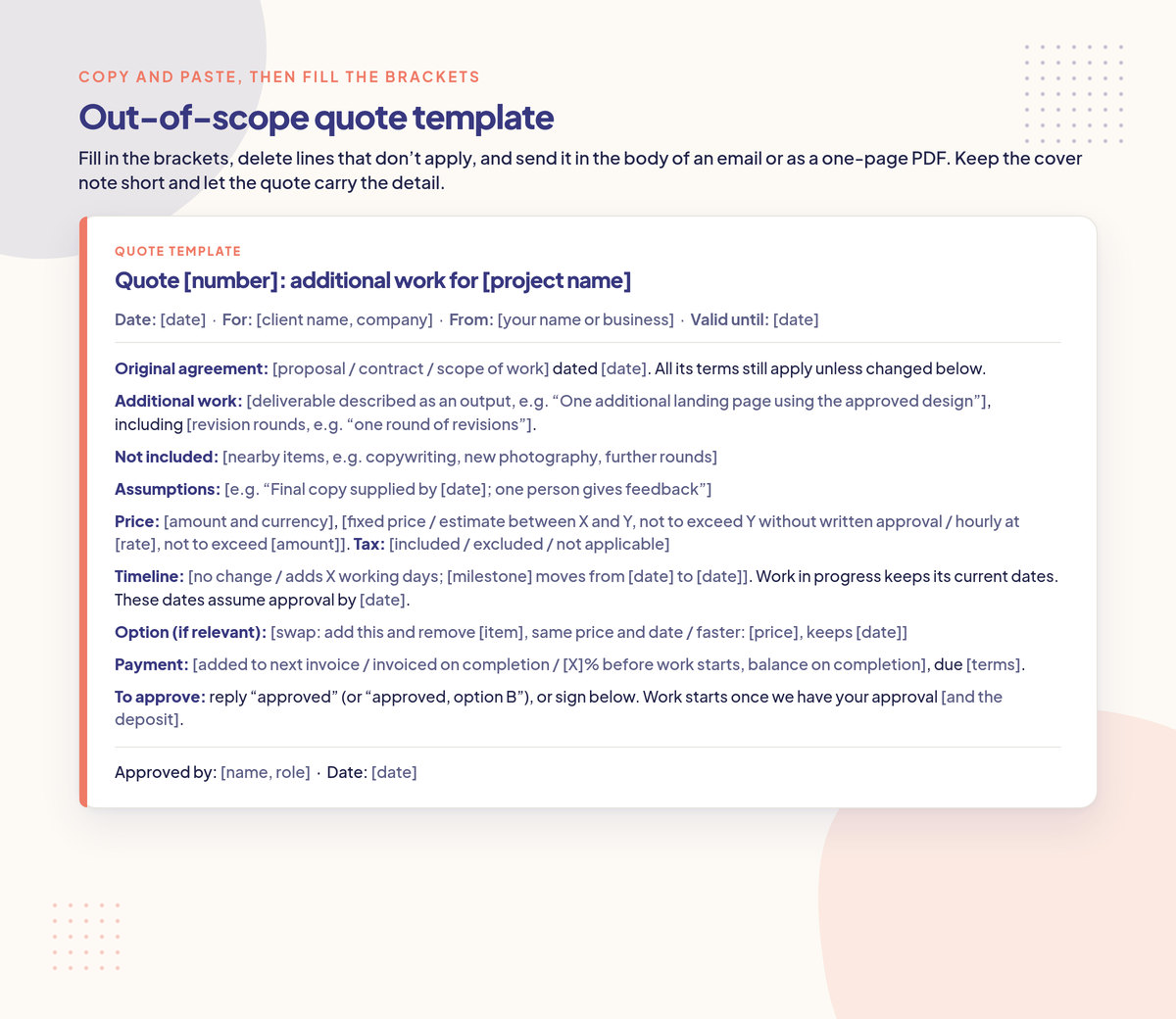
Fill in the brackets, delete lines that don't apply, and send it in the email or as a one-page PDF. Keep the cover note short.
Example (hypothetical): A two-person studio is building a five-page site for a fixed fee. The client asks for one extra landing page for a spring campaign. The studio sends Q-03: valid for 7 days, one landing page using the approved design with one revision round, copy supplied by the client, $400 fixed excluding tax, adds 2 working days to launch, added to the final invoice, approve by replying "approved." It fits on one screen.
Example (hypothetical): Later the same client wants the contact form connected to their CRM, and nobody knows how tidy the CRM is. The studio sends Q-04 as an estimate: $1,000 to $1,500, not to exceed $1,500 without new written approval, with a fixed figure confirmed after the first half day. Because it's larger, half is due before work starts. The quote names what would push it to the top of the range and stays valid for 14 days.
How do you send the quote without a long email?
Send the quote the same day the request arrives, with a short cover note: thanks, it's outside the current scope, here's the quote, reply to approve. Put the detail in the quote, not the email. If several small requests land in the same week, it's fine to collect them and quote them together.
The cover note can be this short:
Thanks for this. It's outside the scope we agreed, so I've put the details in a quick quote below. If it looks right, just reply "approved" and I'll schedule it.
For harder situations, like a client who thought it was included, use the matching script from how to tell a client it's out of scope or the out-of-scope email templates. The out-of-scope email writer drafts the email from the situation, price, delivery time and tone you choose.
On batching, one freelancer in an r/Freelancers thread about off-scope asks keeps a running list of small add-ons and prices the batch weekly: "one negotiation instead of five." In another thread, about doing extra work before pricing it, a reply suggests logging the free extras too, marked "no charge this time." Both fit neatly with numbered quotes.
What happens after the client approves the quote?
Once the client approves, update the scope so it includes the new work, log the approval with its quote number, schedule the work on the new dates, and invoice it as agreed, referencing the quote. That way the next request gets checked against the current scope, not the version from before the change.
File the approval with the quote number, next to the task in your project tool.
Update the scope. Add the new deliverable to your scope of work or a short change log. If it still says five pages after a sixth was approved, the next "small" request has nothing accurate to be checked against.
Schedule it the way the quote said, and protect the in-progress dates you promised.
Invoice it as its own line, with the quote number, so the client's finance person can match it without asking.
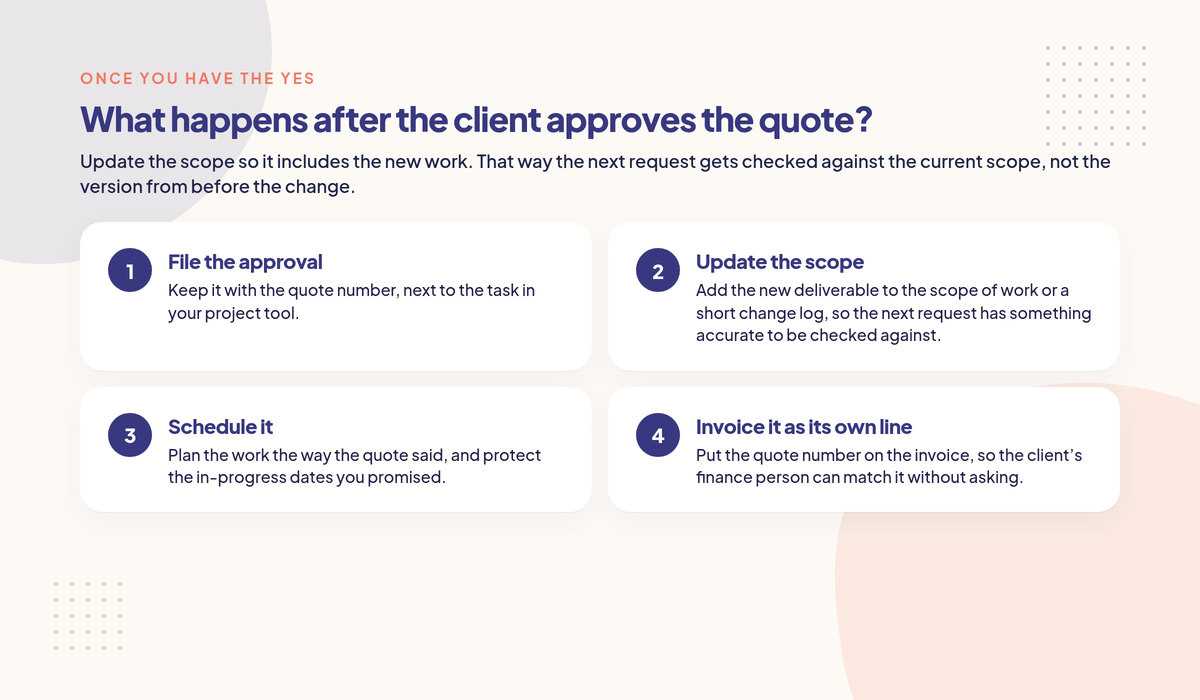
Update the scope once the yes arrives, so the next request is checked against the current agreement, not the old one.
If tracking this across several clients is the part that slips, a scope creep tool can take over the checking and approvals. The scope creep tools comparison sorts the options by the job they do, from change order templates to request checkers. Creepless is one of them: clients send requests through a private link with no login, each request is marked Included, Extra or Needs review against that client's scope, and extras get a suggested price and a drafted message that the client approves from their link before work starts. The how it works page shows the flow.
FAQ: quotes for additional work
Is a quote for additional work legally binding?
Government guides in Australia and the UK say an accepted quote generally forms part of a binding agreement, while an estimate usually doesn't fix the price. Rules vary by country and contract, so treat that as general information, not legal advice. For agency work, the safe habit is a written quote and a written yes.
What's the difference between a quote and an estimate?
A quote is a fixed price for clearly defined work. An estimate is an informed guess that can change once the real extent of the work is known. If you estimate extra work, say what could move the number, add a ceiling you won't pass without approval, and confirm a fixed figure as soon as you can.
How long is a quote valid for?
As long as the quote says. There's no universal rule, so set a period that matches your schedule, often days to a couple of weeks for mid-project extras, and print the expiry date. If it lapses, send a fresh quote with a new number instead of quietly honouring old dates.
Should a quote include tax?
It should say clearly whether the price includes or excludes tax such as VAT or GST, where that applies to you. Citizens Advice lists "if the price includes VAT" among the things a quote should show, and business.gov.au asks for GST where applicable. One short line avoids a surprise on the invoice.
Do you need a new contract for additional work?
Usually not. Most additions can go on a quote or change order that references the original agreement and says its terms still apply. A new contract makes more sense when the extra work is large, very different from the original project, or starts after the first project has finished.
The short version
A good quote for additional work is short and specific. It points to the original agreement, describes the new output and what isn't included, says whether the price is fixed or an estimate with a cap, shows the new dates, sets payment terms and an expiry date, and asks for one written yes. Nothing starts until that yes arrives, and the scope gets updated once it does.
Keep the quote short and specific, get one written yes, and update the scope once it arrives.
Work out the number with how to price a change request, word the message with the out-of-scope scripts or the email writer, and use the template above for the quote in between.
Creepless checks every client request against the scope you agreed.