Scope Creep vs Scope Change: Where Change Orders Fit
Scope creep vs scope change: one is unapproved, unpriced growth, the other is agreed and priced. See the difference, a comparison table and the fix.
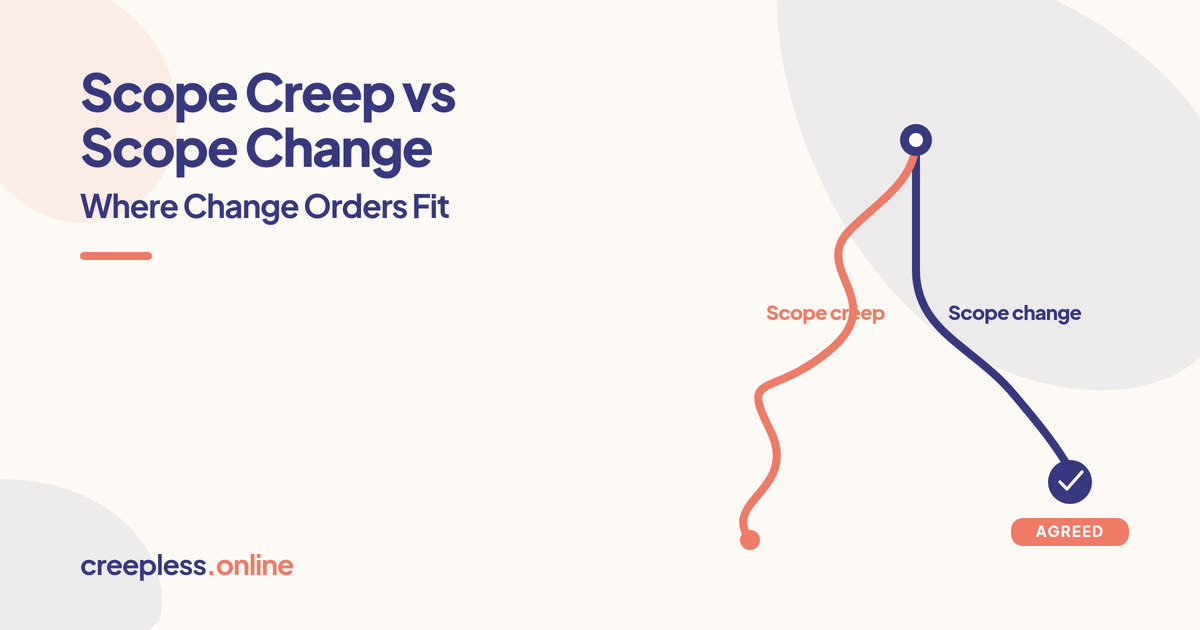
Scope creep vs scope change comes down to one question: did anyone agree to it? Scope creep is work that grows without approval, a price or new dates. A scope change is the same growth, agreed in writing, with its effect on price and timeline spelled out. A change order is the paper that turns the first into the second.
So the two aren't rivals. One is the problem, and the other is what the problem looks like once it's been handled properly. This post explains the difference in plain terms, puts scope creep, scope change and change orders side by side in one table, and shows how a request moves from one column to the other (and how an approved change can slide back into creep). For the price itself, use how to price a change request. For contract wording, use the scope creep clause guide.
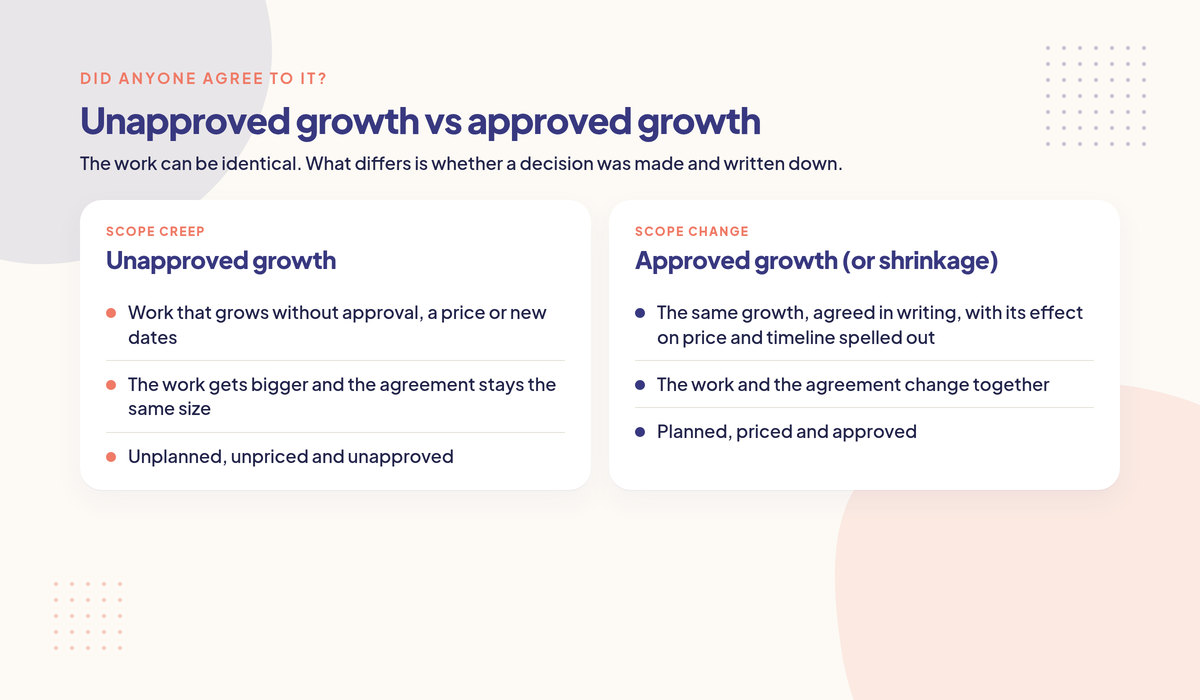
The work can be identical. What differs is whether a decision was made and written down.
What is the difference between scope creep and scope change?
Scope creep is extra work that slips into a project without anyone approving it or adjusting the price and dates. A scope change is a deliberate, acknowledged change to the agreed work, usually with a new price, new dates, or both. The work can be identical. What differs is whether a decision was made and written down.
A 2012 PMI PM Network piece in which five project professionals discuss preventing scope creep puts it plainly. Consultant Trevor K. Nelson says "change and creep are not the same": creep is doing things outside the scope "without approval" and "without an agreement for additional payment," while a scope change is any change or addition that's acknowledged by the person in charge.
That framing matters, because it means the fix for scope creep isn't saying no to change. Clients learn things mid-project. They see the first draft and realise they need a blog or a second language. Chuck Millhollan, in a PMI Global Congress paper on scope change control, writes that "scope change is inevitable" and that the job "is not to stop scope change, but to successfully manage that change."
So a useful way to hold the two terms in your head:
Scope creep is unapproved growth. The work gets bigger and the agreement stays the same size.
A scope change is approved growth (or shrinkage). The work and the agreement change together.
If you want the longer definition, with examples by agency type, the what is scope creep guide covers it. This post stays on the comparison.
Where does a change order fit in?
A change order is the written record of an approved scope change: what's being added, removed or swapped, what it costs, how it moves the dates, and the client's signature or written yes. It's the remedy for scope creep. Scope creep has no paperwork. A scope change normally does, and the change order is that paperwork.
AIGA's guide to writing design proposals describes a change order as a document the designer drafts "to acknowledge a client request that is outside of the original scope." It states the extra time and money, goes to the client "for review and an authorized signature," refers back to the original proposal, and is invoiced separately. AIGA calls it "essentially a mini-proposal," which is a good way to think about it.
Three terms tend to get mixed up, so here's how they relate:
Change request: the ask. It might come as an email, a call or a comment on a draft. On its own, it doesn't change the deal.
Scope change: the decision. Both sides agree the work is changing, and how.
Change order: the document that records the decision, with the price and dates, and gets signed before the work starts.
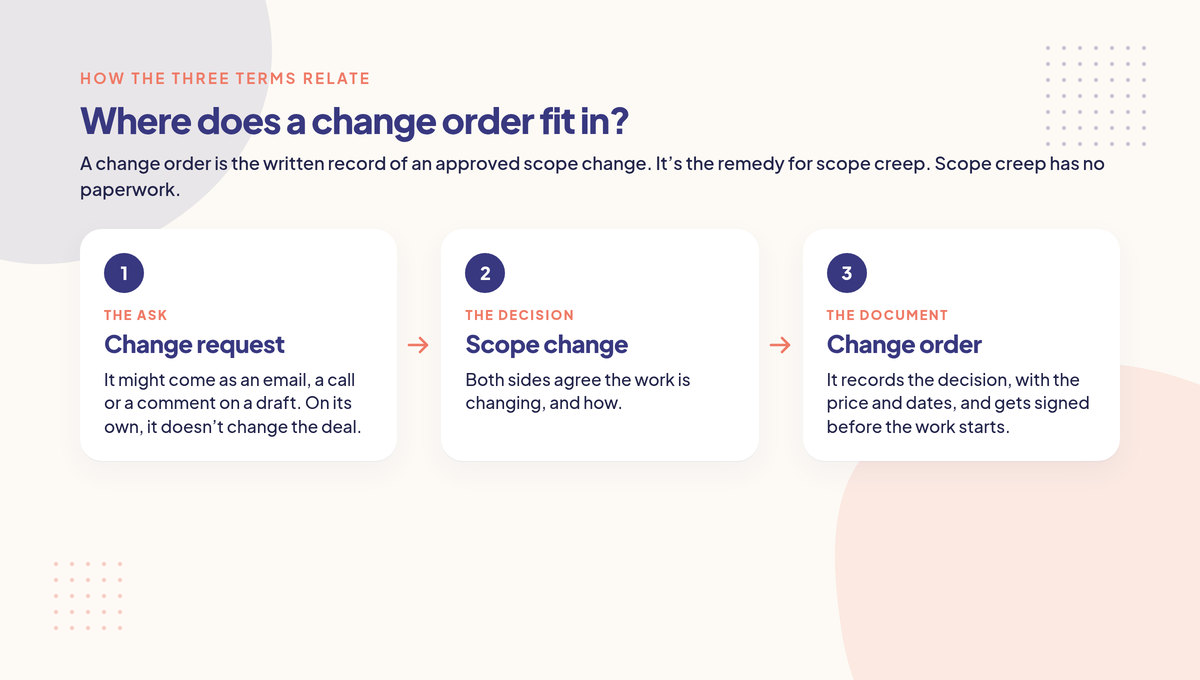
A change order is the written record of an approved scope change. Scope creep has no paperwork.
Some agencies use a light change request form for small additions and a full change order for fixed-price projects. The change order template page explains when each one fits, and the free change order generator builds the document for you from a few fields (who and what, the change, the price, and the schedule and contract value).
Scope creep vs scope change vs change order: a comparison table
Scope creep is unplanned, unpriced and unapproved. A scope change is planned, priced and approved. A change order is the signed document that proves the second happened. The table below compares all three on the points that decide whether you get paid for the extra work.
Scope creep | Scope change | Change order | |
|---|---|---|---|
What it is | Work that grows without a new agreement | An agreed change to what's being delivered | The written record of that agreement |
How it starts | "Can you just..." in a call, chat or email | A change request that gets assessed | Drafted by you after the request is assessed |
Who decides | Nobody, really. It happens by default | The client's approver and you, on purpose | Signed by the client's approver (and often you) |
Approval | None, or assumed | Explicit and written | It is the approval |
Price | Absorbed by you | Agreed before the work (can be zero, or a credit) | Stated on the document |
Dates | Old deadline stays, so the team squeezes | Moved or confirmed as part of the decision | Stated on the document |
Direction | Almost always more work | More, less or a swap | Whatever the change is |
Paper trail | Scattered messages, if any | A decision both sides can point to | One document, numbered and filed |
What happens to the scope | The written scope stays the same while the real work grows | The scope is updated to match | It becomes part of the scope record |
Effect on your margin | Goes down, usually unnoticed | Protected | Protected, and easy to invoice |
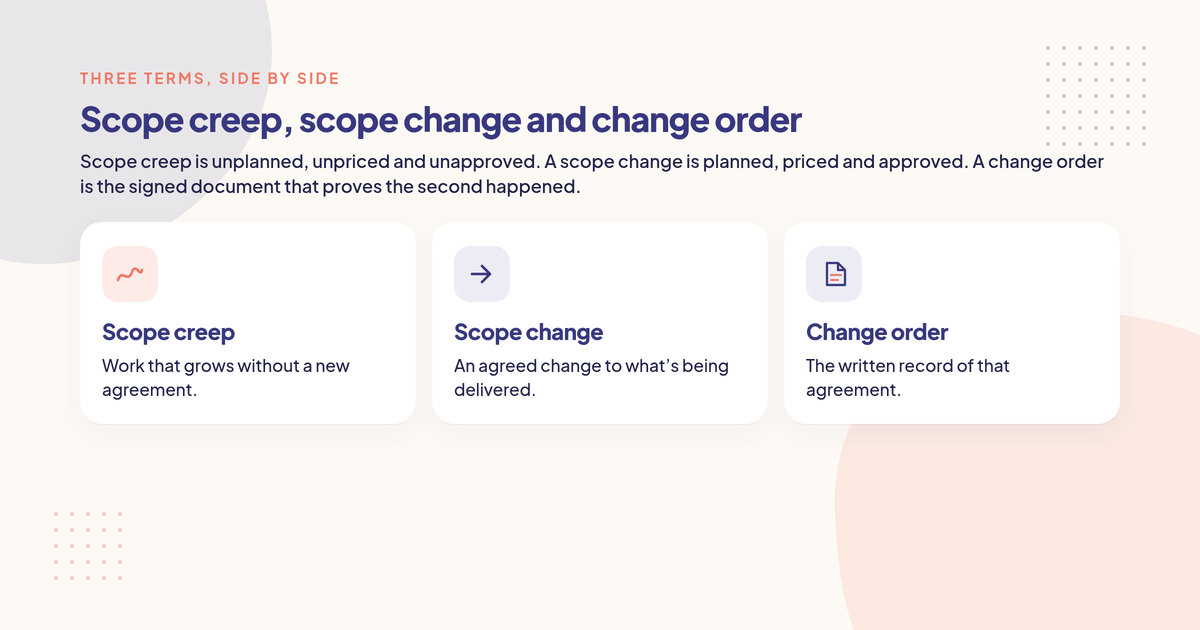
Scope creep is unplanned, unpriced and unapproved. A scope change is planned, priced and approved. A change order is the signed document that proves the second happened.
The row people skip is "what happens to the scope." With scope creep, the written scope and the real project drift apart. With a scope change, they get back in line. That's the whole job.
Is scope creep the same as scope change?
No. They describe the same kind of event, a project getting bigger or different, with opposite outcomes. Scope creep is the version where nobody decided anything, so you carry the cost. A scope change is the version where the client agreed to the new work and its effect on price and dates first.
The easiest way to see it is one request handled two ways.
Example (hypothetical): A studio is building a five-page website for a fixed fee. Halfway through, the client writes: "Could we add a simple blog? Just a listing page and a post template." The studio estimates it at about 8 hours, or $600 at its rate.
Path A, scope creep. The designer replies "Sure, no problem," because the client is nice and the project is going well. The blog gets built over two weeks, squeezed between the agreed pages. The launch slips by a few days, and the client asks why. Nobody mentions the blog, because nobody wrote it down. The fixed fee doesn't move. Then the client asks for categories, because "it's a blog, they all have categories." That's creep on top of creep.
Path B, scope change. The designer replies: "Happy to add that. A blog listing page and one post template is outside the five pages we agreed, so it would be $600 and push launch back by three working days. Want me to send the change order?" The client says yes. A one-page change order goes out, gets signed, and the scope document now says six templates, not five. When the categories question arrives later, the designer can check it against an up-to-date scope and treat it as its own request.
Same client, same blog, same hours. In Path B the studio gets paid, the delay is expected, and the next request has a clear starting point.
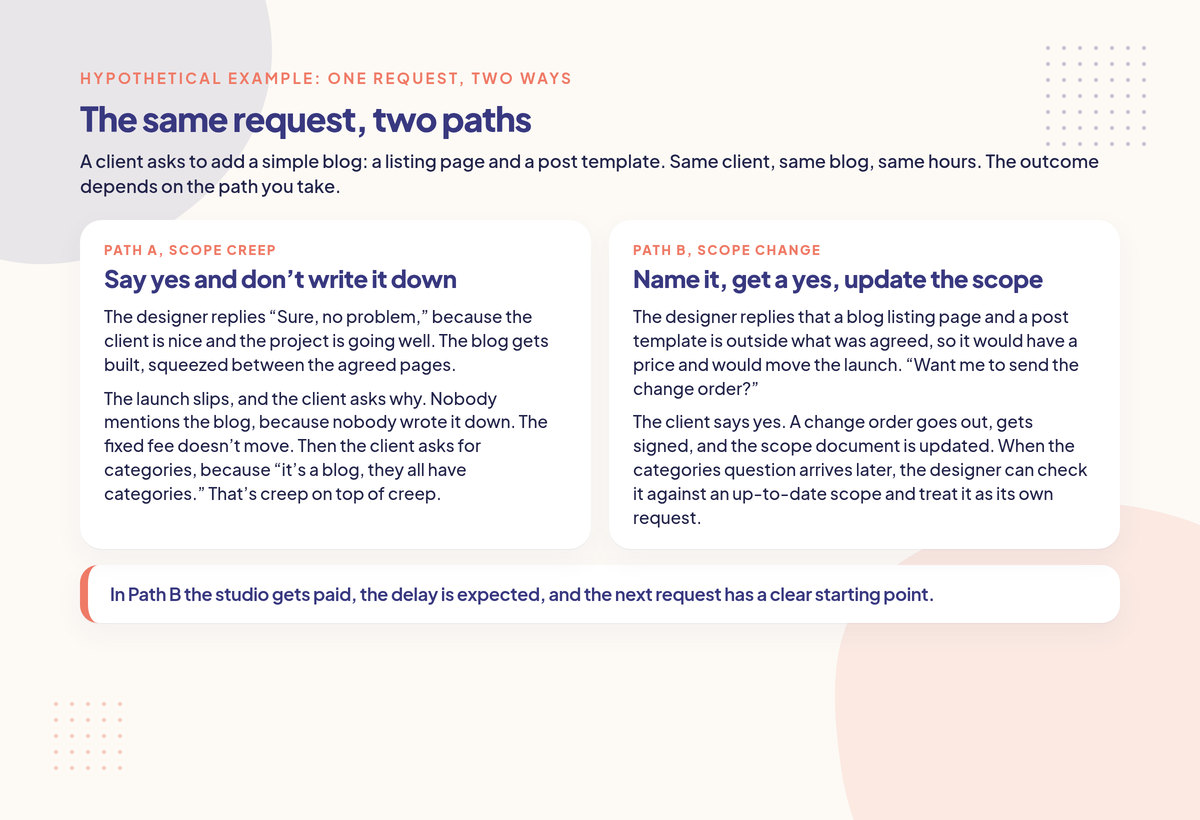
Same client, same blog, same hours. The outcome depends on the path you take.
How does scope creep turn into a scope change?
Catch the request before the work starts, check it against the written scope, tell the client it's extra, and get a written yes on a price and a date. Then update the scope document, so the next request is checked against the new version, not the old one.
In order:
Have a scope you can check against. You can't call something extra if the scope never said what was included. A scope of work with deliverables, limits and exclusions is the baseline. Without one, everything is arguable.
Catch it at the request, not at the invoice. The cheapest moment to convert creep is before anyone opens a file. Once the work's done, you're negotiating about something the client already has.
Name it, neutrally. "That's outside what we agreed, so here's what it would take" is enough. You don't need to make it a big moment. If you want ready-made wording, the out-of-scope scripts cover the common cases.
Describe the change and its effect. What's being added, removed or swapped, what it costs, and how it moves the dates. The pricing method (new work, knock-on rework, timeline cost) is in how to price a change request.
Get the yes in writing, before work starts. A signed change order for bigger or fixed-price work, or a clear written reply for small additions, from the person who can approve spending.
Update the scope and log the change. This is the step people forget, and it's the one that stops the change from creeping again.
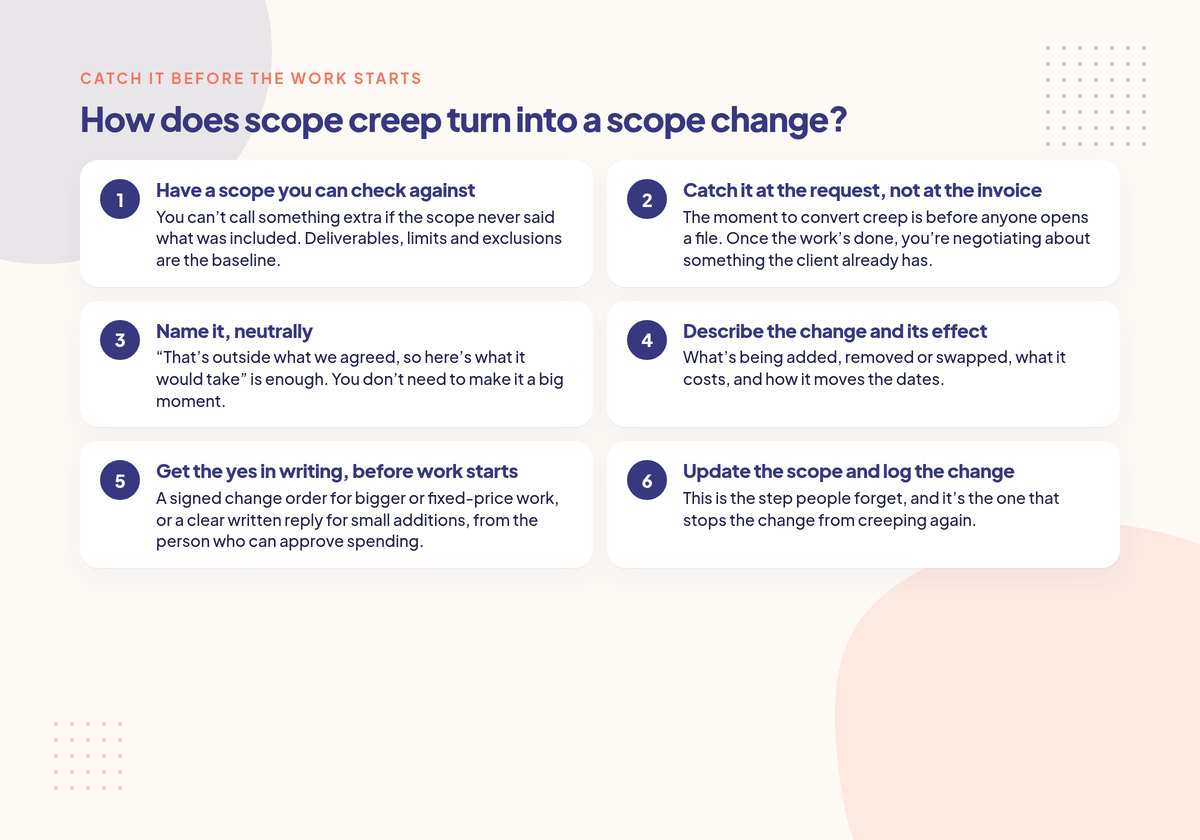
Catch the request before the work starts, get a written yes, then update the scope so the next request is checked against the new version.
The UK government's project delivery guidance (the Teal Book, chapter 22 on change control) is written for public projects, but the core idea scales down well. It says changes should go through a structured process "that protects the baseline against scope creep," that every change request should be assessed for impact, and that an approved change is "integrated into baselined plans." For a small agency, the "baselined plan" is just your scope of work and your project schedule. Update both.
The same guidance tracks each change through simple statuses: requested, assessed, approved, deferred, implemented and closed. You don't need software for that. A column in a shared sheet is fine. What matters is that "requested" and "approved" are visibly different things, so no one starts work on a request that's still only requested.
What if the work's already been done? You can still ask, but the conversation is harder and the outcome is less certain. How to price a change request has a section on what to do if you've been doing changes for free, and the guide to how to calculate scope creep cost helps you put a number on what it's been costing you.
How can an approved scope change turn back into scope creep?
It happens when the work grows past what was approved, when nobody updates the scope document, or when the approval was vague about price, dates or who signed off. The change order covers the request as written. Anything beyond it is a new request, even if it feels like part of the same thing.
Most comparisons skip this part, and it's where small teams lose money after doing everything "right." Common ways it happens:
The change grows after approval. The client approved "a blog listing page and one post template." Then come categories, an author page, a newsletter signup in the sidebar. Each one feels like it belongs to the approved blog. None of them was on the change order. Treat each as its own request and check it against the updated scope.
The scope document never got updated. The change order sits in someone's email, but the project brief still says five pages. Three weeks later, a new team member reads the brief and assumes the blog was a favour. Or the client's new marketing lead reads it and thinks the blog came free. Millhollan's paper lists the people every project manager ends up controlled by without change control, including "stakeholders with bad memories about what was (or was not) in scope." An updated scope is your defence against everyone's memory, including yours.
The approval was fuzzy. "Yes, go ahead with the blog" in a call, with no price mentioned, isn't really an approved scope change. It's an approval of the idea. If the invoice later shows $600, the client may feel ambushed. Millhollan is blunt about this: "there's no such thing as informal change control."
The wrong person said yes. A junior contact approves a change that their manager later refuses to pay for. The change was agreed, but not by someone who could agree to spend. Put the approver's name in the scope at kickoff and get approvals from that person.
The knock-on work wasn't counted. Adding a blog may mean reworking the navigation, the footer and the sitemap you already built. If the change order only priced the new pages, the rework becomes creep inside an approved change. That's why rework belongs in the price (see how to price a change request for the formula).
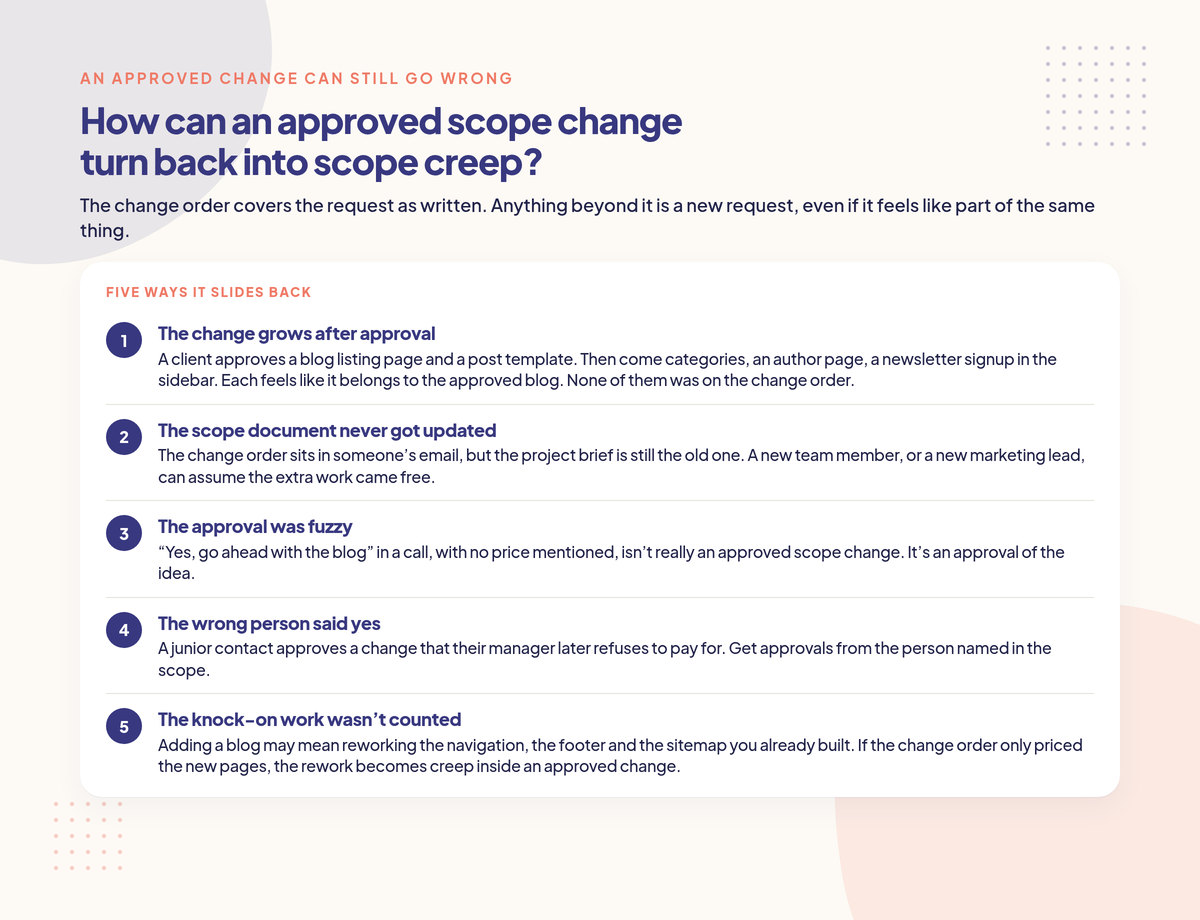
The change order covers the request as written. Anything beyond it is a new request, even if it feels like part of the same thing.
Example (hypothetical): A marketing freelancer has an approved change order to add two extra landing pages to a campaign. The pages are built. Then the client asks for both to be A/B tested with three headline variants each. That's not the landing pages anymore. It's testing work, with its own setup and reporting. The freelancer points to the change order ("two landing pages, built and handed over") and sends a separate quote for the testing.
What counts as an approved scope change for a small agency?
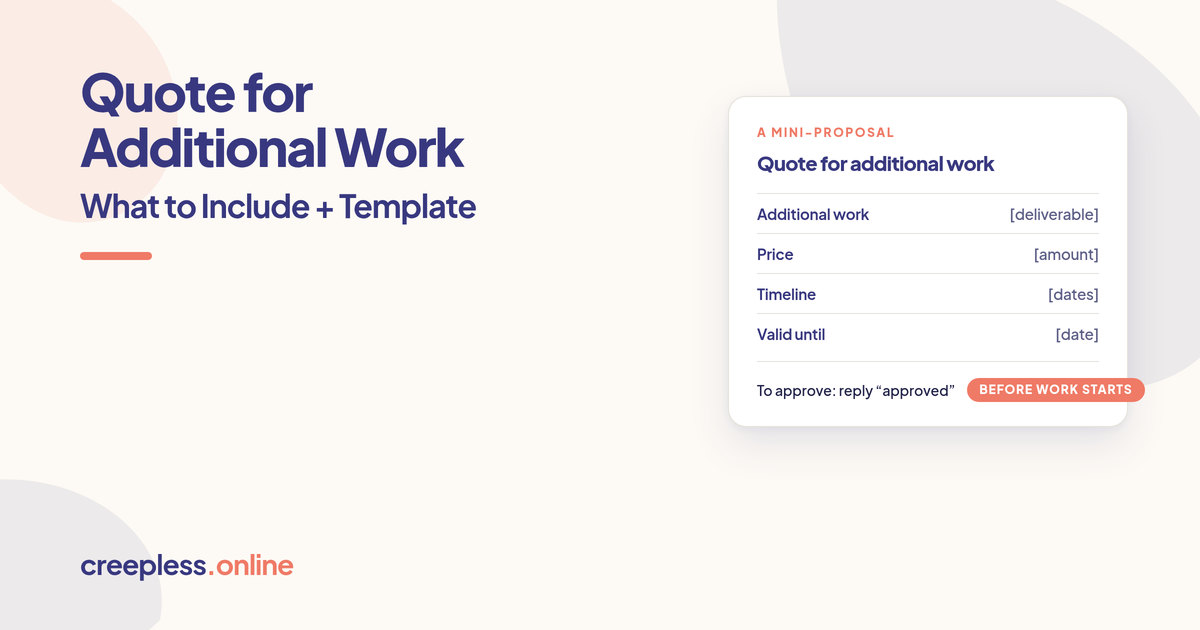
For a small agency or freelancer, it's a written yes from the client's named approver to a described change, with its price (even if that's zero) and its effect on dates. The format can be a signed change order, a change request form or a clear email reply. The content matters more than the form. A quote for additional work is one way to put that content in writing, with the extra work, the price and the dates in one place.
You don't need a change control board. The usual forms:
A signed change order. Best for fixed-price projects and larger changes, because it amends the agreed total and keeps a running contract value. The change order generator shows the parts.
A change request with a written approval. Lighter, and common on retainers where small extras come up every month. The change request form is a simple version.
A swap. The client trades one deliverable for another of similar size, and the price stays the same. It's still a scope change, so write it down.
A reduction. The client drops a page or a feature. Scope changes can go down as well as up, and a reduction can come with a credit or a lower fee. Record it, so nobody later thinks it was "forgotten."
A deliberate favour. You decide to do something extra for free, on purpose. That's fine, and it's your call. Write it down as a change at no charge, so it's a gift the client knows about rather than a precedent nobody noticed.
A new project. When the ask is big enough to be its own job, quote it separately instead of stretching the old scope.
On retainers, the same logic applies, but the baseline resets each month. How to handle extra work on a retainer covers the monthly version.
What isn't scope creep?
Not every extra hour is scope creep. Included revisions, fixes to your own mistakes and detail you're expected to work out within the agreed scope aren't creep. A missed requirement found mid-project isn't either, though it still needs a decision. A few nearby terms are worth separating before you send a change order.
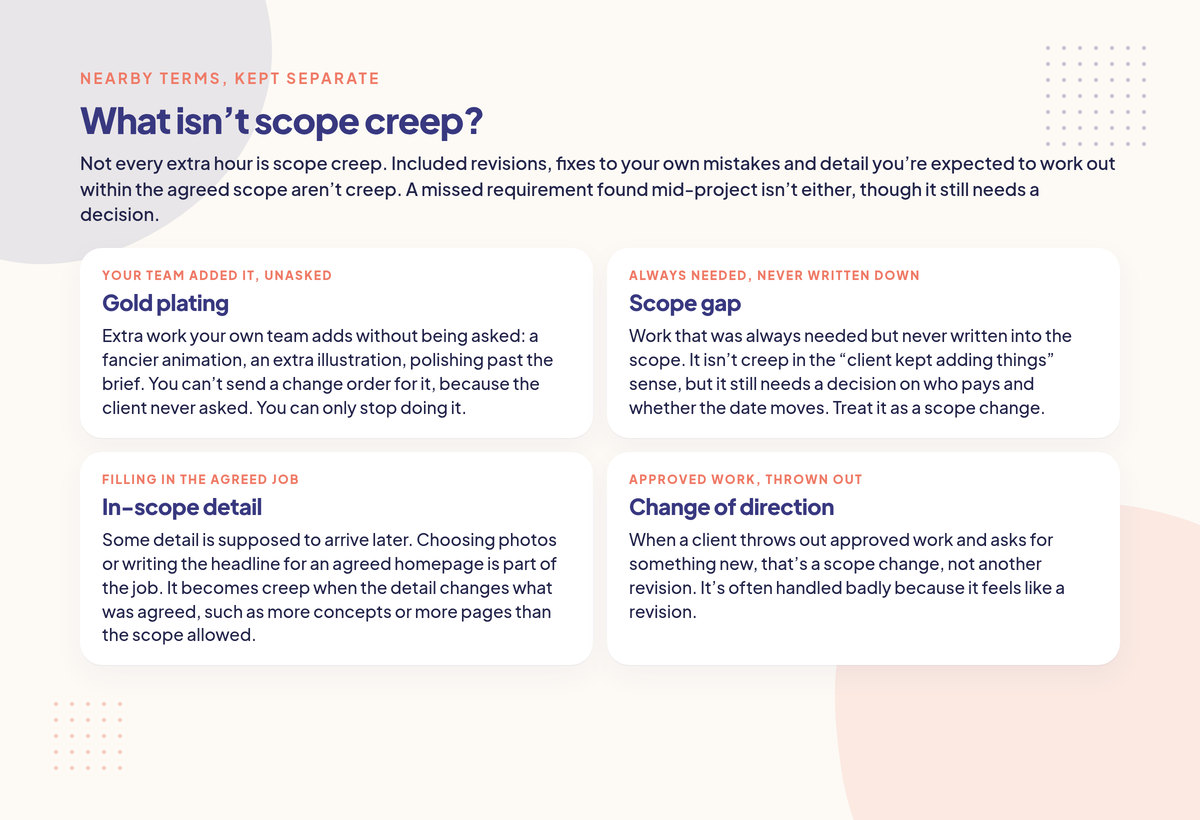
Not every extra hour is scope creep. Included revisions, your own fixes, missed requirements and in-scope detail still need a clear decision, but they are not the same thing.
Included revisions and your own fixes
If the scope includes two revision rounds per deliverable, those two rounds aren't creep, however annoying they feel. Fixing your own typo or broken link isn't creep either; the fee already covers it. Creep starts after the included rounds run out, which is why it helps to track client revision rounds visibly, and to know how to charge for extra revisions when the limit is reached.
Scope creep vs gold plating
Gold plating is extra work your own team adds without being asked: a fancier animation, an extra illustration, polishing past the brief. Scope creep usually comes from client requests. Both add unapproved work, and both cost you hours. The difference is who started it. You can't send a change order for gold plating, because the client never asked. You can only stop doing it.
Scope creep vs scope gap (missed scope)
A scope gap is work that was always needed but never written into the scope. Say the site needs a cookie banner, or old content needs migrating, and nobody listed it. It isn't creep in the "client kept adding things" sense, but it still needs a decision on who pays and whether the date moves. Treat it as a scope change. A paid discovery phase before the main quote is one way to find these gaps early.
Detail being worked out inside the scope
Some detail is supposed to arrive later. "Homepage design, two concepts" doesn't say which photos or what the headline is, and filling those in is part of the job. That's not creep. It becomes creep when the detail changes what was agreed, such as two concepts becoming four, or one homepage becoming a homepage plus three campaign variants.
A client who keeps changing direction
When a client throws out approved work and asks for something new, that's a scope change, not another revision. It's often handled badly because it feels like a revision. How to handle a client who keeps changing their mind covers how to tell the two apart.
How do you keep scope changes from becoming scope creep?
Keep a written scope with exclusions, give clients one place to send requests, check each request against the scope before anyone starts, and get a written yes on the price and dates for anything extra. Then update the scope and log the change. The habit matters more than the template, because creep wins whenever the check gets skipped.
A few habits do most of the work:
Write exclusions, not just inclusions. "Five page templates" leaves room for a debate. "Five page templates; a blog, extra languages and e-commerce are not included" doesn't. The scope of work template has a slot for both.
Put the change rule in the contract. One paragraph saying extra work needs a written approval on price and dates before it starts. The scope creep clause has sample wording for projects and retainers.
Keep one channel for requests. Asks spread across chat, email, calls and comments are easy to miss and easy to say yes to without thinking.
Check every request against the scope before you reply. Most creep happens in the reply, not the work. A quick "I'll check this against the scope and come back today" buys you the time.
Keep a change log. Number, date, what changed, price, dates, approver, status. It's how you see whether one client is generating most of the changes, and it's what you point to when someone's memory differs from yours.
This is the job a scope creep tool is meant to do: put the scope where the requests arrive, so the check happens every time instead of only when someone remembers. In Creepless, for example, each client gets a private request link with no login, every request is marked Included, Extra or Needs review against that client's scope, and extras become a quote that the client approves before work starts (how it works). A spreadsheet and some discipline can do the same thing on a small client list. The tool matters less than doing the check every single time.
FAQ: scope creep vs scope change
Is a change request the same as a change order?
No. A change request is the client's ask; it doesn't change the deal on its own. A change order is the document that records an agreed change, with the price, dates and the client's approval. Many agencies use both: the request starts the conversation, and the order closes it. The change order template page explains when to use each.
Can scope creep be approved after the fact?
Sometimes. You can send a change order for work already done, but the client never got the chance to say no, so expect pushback and be ready to accept less. It works best when the extra was clearly outside the written scope and you raise it quickly. Next time, catch it at the request.
Who is responsible for scope creep, the client or the agency?
Usually both, but the agency has more control over it. Clients ask for things; that's normal. Creep happens when the agency does the work without checking it against the scope or asking for approval. A clear scope, a change rule in the contract and a habit of replying to extras with a price put the decision back on the table.
Can a scope change make a project smaller?
Yes. A scope change can remove work as well as add it. If a client drops a deliverable, write it down as a change, agree what happens to the price (a credit, a lower fee or a swap) and update the scope. Unrecorded reductions cause disputes too, especially when someone later asks where the missing piece went.
Is gold plating a type of scope creep?
It's closely related. Gold plating is extra work your own team adds without being asked, while scope creep usually comes from client requests. Both add work nobody approved and both eat margin. The fix differs: client creep gets a change order, while gold plating gets stopped internally, by working to the written scope.
The short version
Scope creep is growth nobody agreed to. A scope change is growth (or shrinkage) both sides agreed to, with the price and dates adjusted. A change order is the document that makes the change official. Catch requests before the work starts, check them against a written scope, get a written yes, and then update the scope so the next request is checked against the current version.
To put it into practice, start with the change order template or the change order generator, price the work with how to price a change request, and look at the scope creep tools comparison if you want the check built into how clients send requests.
Creepless checks every client request against the scope you agreed.