What Should Be Included in a Retainer Agreement
A practical checklist of what to put in a retainer agreement: included work, exclusions, caps, how extras are approved, plus a copy-paste scope outline.
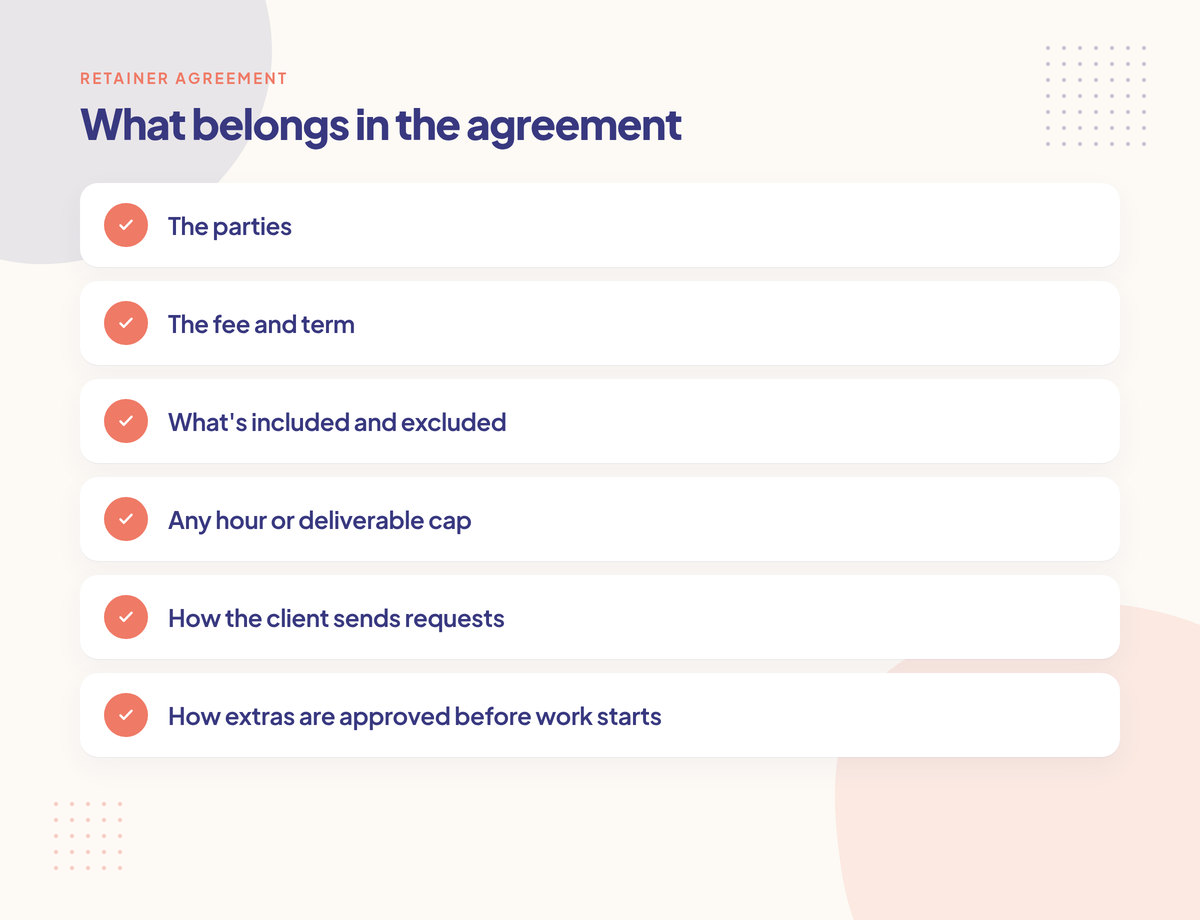
Here's what should be included in a retainer agreement: the parties, the fee and term, what's included and excluded, any hour or deliverable cap, how the client sends requests, and how extras are approved before work starts. Get those commercial terms down clearly, then have a lawyer review the final contract. This is a practical checklist for web, marketing and freelance retainers, not legal advice.
What should be included in a retainer agreement?
You can draft the commercial terms yourself: parties, fee and term, a countable inclusions list, exclusions, a cap, one request path, and a rule that extras are quoted and approved in writing before anyone starts. Legal clauses like IP, confidentiality and termination still belong in the contract, but a lawyer should review those. This post is a practical checklist, not legal advice.
Think of the document in two layers. The first is the commercial baseline: what the client is buying each month, what they are not, and what happens when they ask for something else. You can draft that yourself. The second is the legal wrapping (ownership of work, confidentiality, liability, governing law). A lawyer who knows the law where you work should check that layer.
If you already have a scope of work template, attach a retainer-shaped version as an exhibit and keep the legal contract shorter. The exhibit is what you'll both look at when a mid-month request arrives.
What does the scope section need to say?
The scope section is the baseline for the month: a countable list of included work, a clear exclusions list, and a cap on hours, tickets or revision rounds. If a later request isn't on that list, or would break the cap, it's extra. Vague phrases like "ongoing support" or "as needed" are what start arguments.
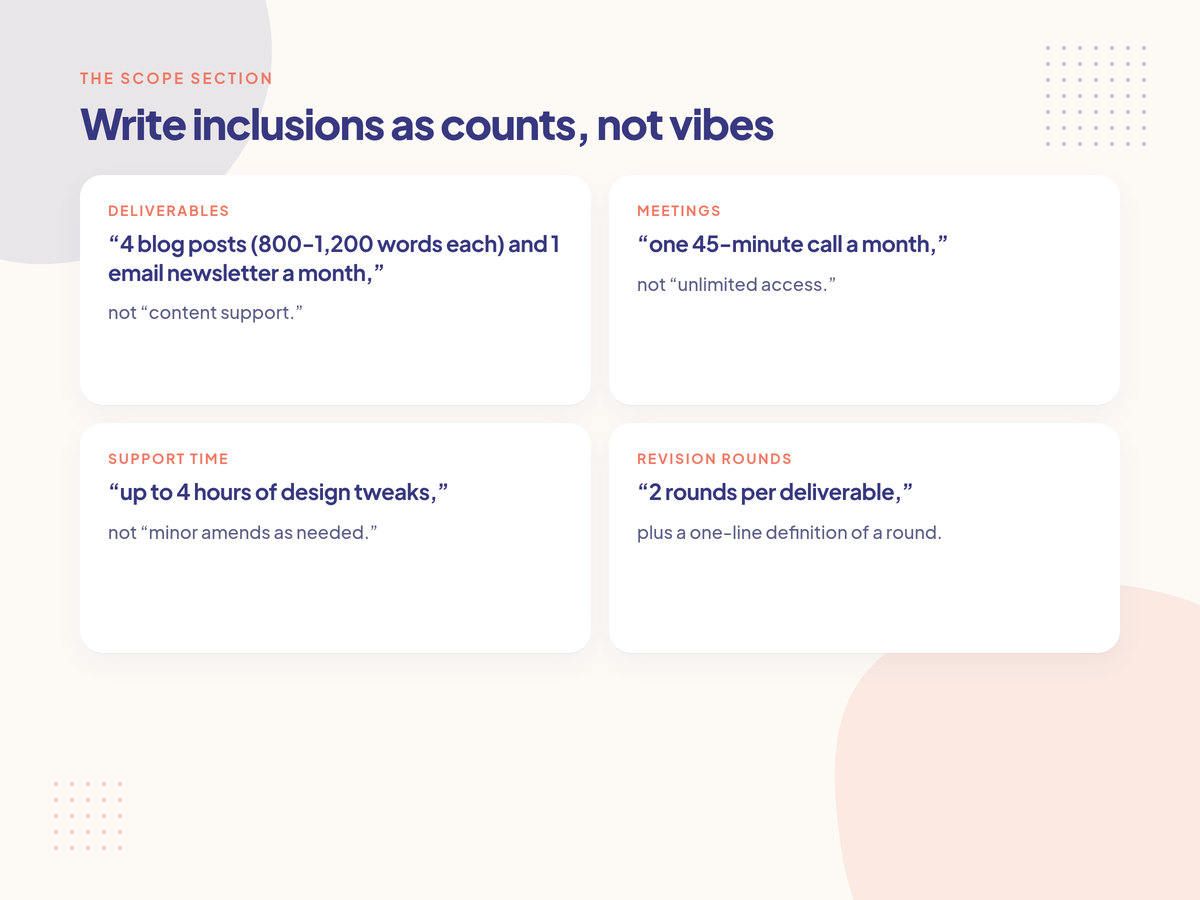
Write inclusions as counts or hours, not vibes:
Deliverables: "4 blog posts (800-1,200 words each) and 1 email newsletter a month," not "content support."
Meetings: "one 45-minute call a month," not "unlimited access."
Support time: "up to 4 hours of design tweaks," not "minor amends as needed."
Revision rounds: "2 rounds per deliverable," plus a one-line definition of a round. See how to charge for extra revisions if you need that wording.
Then write the exclusions. Name the things clients often assume come with the fee: new pages or campaigns, new platforms, photography, paid media spend, weekend or rush work, printing, travel, or a full redesign. You don't have to exclude all of them. You have to say which ones are out, and that they're quoted separately.
Finally, put a cap on the month: hours, tickets, deliverable counts, or a mix. Without a cap, an hours-based retainer has no upper edge, and a deliverables retainer still leaks through "quick" extras.
The Association for Project Management describes change control as capturing a request, evaluating it against the approved baseline, and then approving, rejecting or deferring it. If the agreement never names that baseline, you have nothing solid to evaluate against.
How should the agreement handle work that isn't included?
The agreement should say that work outside the included list, or past the month's cap, is quoted separately and doesn't start until the client approves it in writing. Name the request channel, the pricing rule you'll use, and that a verbal "can you just..." isn't approval.
A short extras section needs four things:
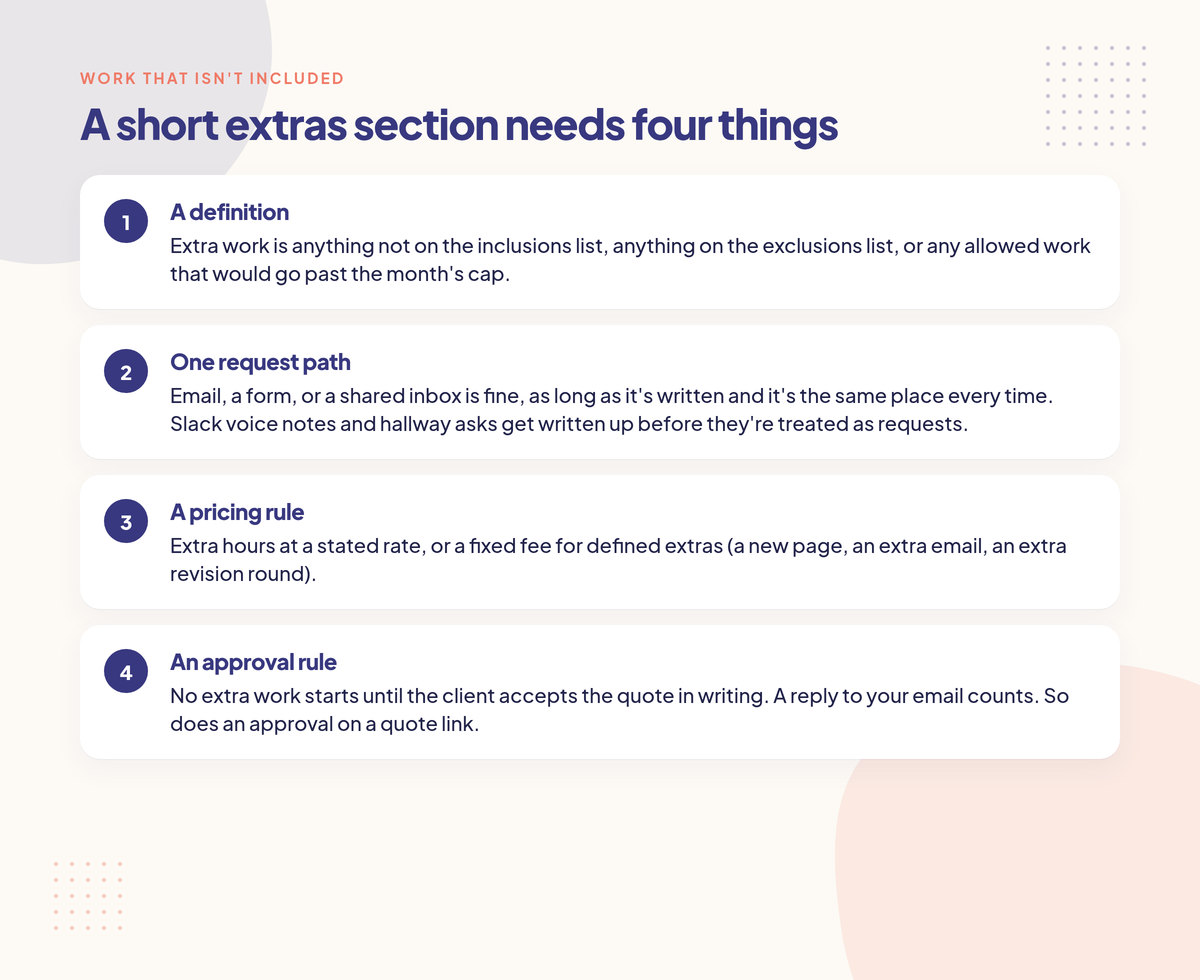
A definition. Extra work is anything not on the inclusions list, anything on the exclusions list, or any allowed work that would go past the month's cap.
One request path. Email, a form, or a shared inbox is fine, as long as it's written and it's the same place every time. Slack voice notes and hallway asks get written up before they're treated as requests.
A pricing rule. Extra hours at a stated rate, or a fixed fee for defined extras (a new page, an extra email, an extra revision round). Inventing the price at the moment of the ask always feels negotiable.
An approval rule. No extra work starts until the client accepts the quote in writing. A reply to your email counts. So does an approval on a quote link.
That's the same idea as a scope creep clause, and you can reuse the wording from that post. A change request form keeps the scope, price and sign-off in one place.
If a month can run out of hours, say what happens next: extra hours at a stated rate, or the work moves to next month. The agreement should also say whether unused hours expire or carry over, and whether any carry-over has a cap. Write both rules down so a mid-month quote isn't improvised. How you handle the request when it arrives is covered in how to handle extra work on a retainer.
Once the rules are written, they have to be used. In Creepless you load the same inclusions, exclusions, revision limits and hour caps as per-client rules. The client sends requests through a private link (no login), and an AI scope referee marks each one Included, Extra or Needs review and cites the rule it used. Extras become a quote the client approves on that link before work starts.
What payment and term details belong in the agreement?
State the monthly fee, when you invoice, when payment is due, what's included in that fee versus billed as expenses, the start date, the term, how renewal works, and how either side can end it. This post won't tell you what to charge; price the fee separately, then write the number you landed on into the agreement.
Work out hours, rate and margin first. The retainer pricing calculator is built for that step. The agreement only needs the resulting fee, plus:
Invoice date and payment due date (for example, invoiced on the 1st, due in 14 days).
Whether the fee is prepaid for the coming month or billed in arrears.
Expenses: what's included versus what needs pre-approval (stock licenses, travel, tools the client requests).
What happens if an invoice is unpaid: you can pause work after written notice. If you want a late-payment or interest rule, ask a lawyer to write one that fits your jurisdiction. This post doesn't offer that advice.
For the term, name the start date, the initial length (month-to-month, three months, six months), how it renews, and how much notice either side needs to end it. Say what happens to work in progress and unpaid invoices when it ends. A lawyer should check the termination wording.
Do you need a lawyer to finish the contract?
Yes, for the final version. A scope checklist helps you agree the commercial terms with the client, but it isn't a substitute for a contract that fits your location, entity type and the work you do. Have a lawyer review IP, liability, termination, data handling and anything else the law in your area requires.
A lawyer will usually look at ownership of work (and when it transfers, often on full payment), your pre-existing templates, confidentiality, client data, a liability cap, disputes and governing law. Those aren't DIY afterthoughts, even if you wrote the scope exhibit yourself.
The UK government's Teal Book guidance on change control puts the same idea in project language: changes are expected, but they should only be implemented through a structured process that protects the baseline. The checklist below is where you make that baseline clear enough to use.
What does a simple retainer scope outline look like?
It can be a short exhibit attached to the contract: included work with counts, exclusions, the cap, the request path, and the extras rule. You fill in the blanks with this client, not with generic "support." Here's a copy-paste outline, then a filled-in hypothetical example.
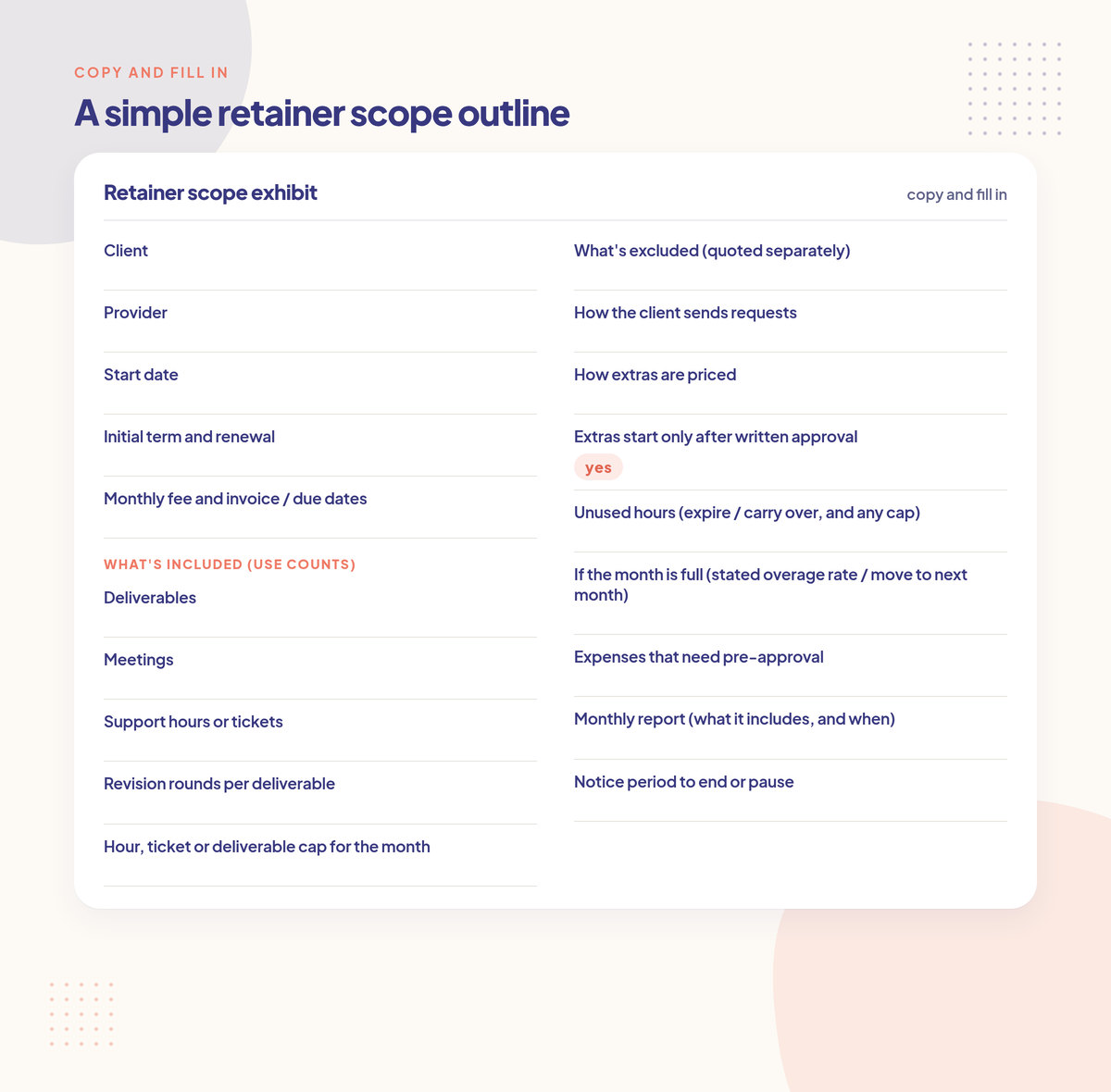
Retainer scope exhibit (copy and fill in)
Client:
Provider:
Start date:
Initial term and renewal:
Monthly fee and invoice / due dates:
What's included (use counts):
Deliverables:
Meetings:
Support hours or tickets:
Revision rounds per deliverable:
Hour, ticket or deliverable cap for the month:
What's excluded (quoted separately):
How the client sends requests:
How extras are priced:
Extras start only after written approval: yes
Unused hours (expire / carry over, and any cap):
If the month is full (stated overage rate / move to next month):
Expenses that need pre-approval:
Monthly report (what it includes, and when):
Notice period to end or pause:
Example (hypothetical): A six-month marketing retainer at $2,000 a month, invoiced on the 1st and due in 14 days. Included: 4 blog posts (about 1,000 words each), 1 email newsletter, one 45-minute planning call, and up to 4 hours of design support. Two revision rounds per deliverable. Excluded: new landing pages, paid ad spend, photography, and weekend rush work. Requests come in by email. Extras are quoted at $120 an hour, or as a fixed fee for a defined item, and don't start until the client replies "approved." Unused design hours expire at month end. If the 4 support hours are used up, further design work is quoted at the same $120 rate or moved to next month, at the client's choice.
Halfway through month two, the client asks for a new product landing page. That item is already on the exclusions list, so it isn't squeezed into the 4 support hours. It gets a separate quote, and work starts only after a written yes. The monthly posts and the remaining design hours continue as planned.
PMI's 2018 Pulse of the Profession, reported in "Scope Patrol", found that 52% of projects completed in the previous 12 months had scope creep or uncontrolled changes, up from 43% five years before. That survey covered project teams in larger organizations, not freelance retainers. PMI's definition still helps: uncontrolled change is work that expands without a matching change to time, cost or resources.
FAQ
What is included in a monthly retainer agreement?
The parties, the monthly fee and term, a countable list of included work, a list of exclusions, a cap, the request path, and a rule that extras are quoted and approved before work starts. Legal clauses such as IP, confidentiality and termination belong in the same contract, reviewed by a lawyer.
Is a retainer agreement the same as a scope of work?
No. The scope of work (or a scope exhibit) describes what a period of work includes and excludes. The retainer agreement is the contract around that scope: fee, term, approval rules and the legal clauses. Many studios attach the scope as an exhibit so they can update the monthly menu without rewriting the whole contract.
How long should a retainer agreement last?
There's no required length. Month-to-month is flexible. A three- or six-month initial term gives both sides some stability. Whatever you pick, write the start date, how it renews, and how much notice is needed to end it. Ask a lawyer to check the termination language.
Should a retainer agreement say what's not included?
Yes. An exclusions list is the fastest way to settle "is this covered?" without a debate. Name the work clients often assume is included, such as new pages, new channels, rush work or paid media, and say those items are quoted separately.
The short version
A retainer agreement is usable when it names what the month includes, what it excludes, the cap, how requests arrive, and that extras need a written yes before you start. Price the fee separately, write the number in, and have a lawyer review the final contract. This checklist is not legal advice. Fill in the outline with this client's work, not with vague promises of support.
Creepless checks every client request against the scope you agreed.