Hourly vs Retainer for Agencies (+ Retainer Pricing Models)
Hourly vs retainer vs fixed price: who carries the risk, when each fits an agency, and how to price an hours-bank, deliverables or tiered retainer.
Hourly vs retainer comes down to one question: who should carry the risk when the work grows? With hourly billing the client does, because every extra hour shows up on the invoice. With a retainer you share it, inside limits you set. With a fixed price you carry it. Pick the model whose risk you can actually manage.
Plenty of agencies use more than one, for different kinds of work. Below: when each fits, the five retainer pricing models (hours bank, deliverables, tiers, value-based and hybrid), how to put a number on a retainer, and how scope creep shows up in each.
What's the difference between hourly, retainer and fixed price?
Hourly billing charges for the time you actually spend. A fixed price charges one amount for a defined result, however long it takes. A retainer charges the same fee every month for an agreed amount of ongoing work, measured in hours, deliverables or both. The difference that matters is who absorbs the extra work.
Business Queensland's guide to pricing strategies describes hourly pricing as common for service businesses and contractors, and puts the contrast plainly: an hourly rate "considers business costs and available time, unlike project-based pricing, which is a flat fee based on a project scope."
The risk side comes from project management. A PMI conference paper on contracts from the buyer and vendor point of view sums it up: "the seller bears most of the risk with a fixed price contract" and "the buyer bears the risk with a time and materials contract." Swap "seller" for agency and "buyer" for client and you have the hourly vs fixed price argument in one line. A retainer sits in between: the client commits to a monthly fee, you commit to a capacity.
Hourly | Fixed price (project) | Monthly retainer | |
|---|---|---|---|
What the client pays for | Time spent | A defined result | Ongoing capacity or a set of recurring deliverables |
Who carries the risk of extra work | Mostly the client | Mostly you | Shared, if the limits are written down |
Your income month to month | Goes up and down with the work | Lumpy, tied to milestones | Steady |
Where scope creep shows up | A bigger invoice the client didn't expect | Hours you don't get paid for | Small asks that quietly eat the month |
Admin | Timesheets and variable invoices | Change orders when scope moves | Usage reports and a monthly check of what's included |
Best for | Unclear or exploratory work, new clients | Clear deliverables with an end date | Recurring work with a fairly steady volume |
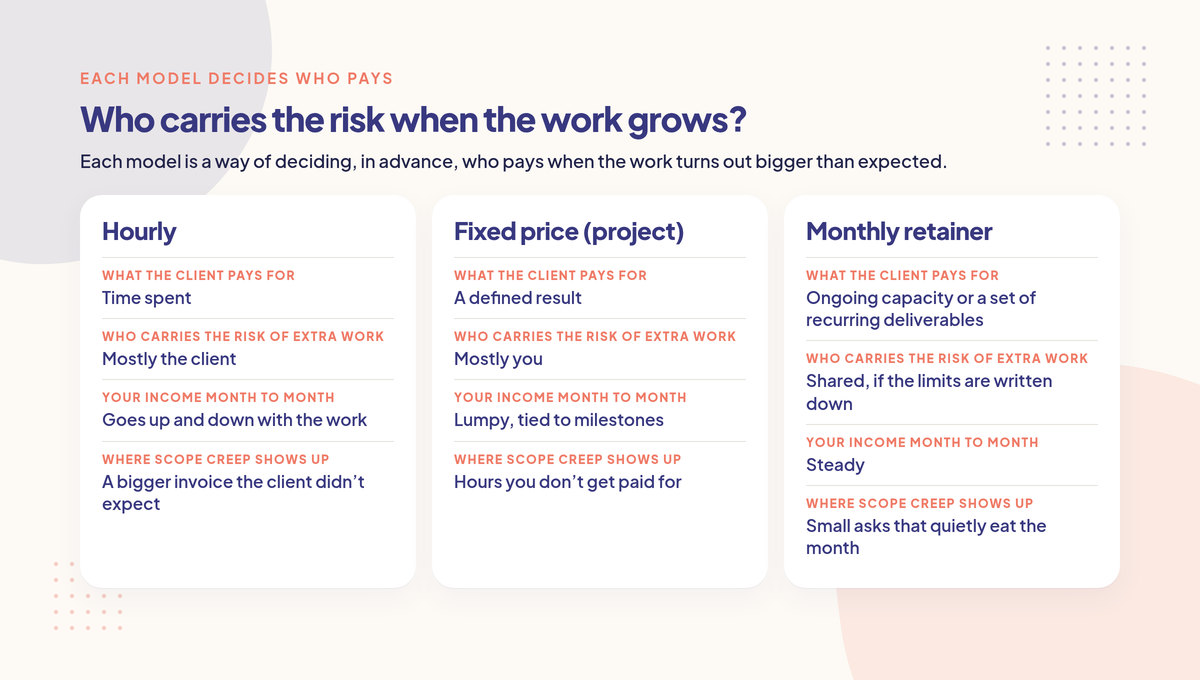
Each model is a way of deciding, in advance, who pays when the work turns out bigger than expected.
Each model decides, in advance, who pays when the work turns out bigger than expected. All of them depend on a scope that says what's in and what isn't, so if that part is fuzzy, start with the what is scope creep guide.
Hourly vs retainer: which is better for an agency?
For ongoing work with a steady volume, a retainer is usually better for an agency: income you can plan around, less invoicing, and a client relationship that isn't renegotiated every month. Hourly is better when the work is unpredictable, short or new. A lot of agencies start a client hourly and move them to a retainer later.
It depends on which problem is costing you more. If you never know what next month looks like, a retainer fixes that. If projects keep running over and you eat the hours, hourly protects you. A badly scoped retainer won't: the fee stays the same while the hours climb.
And if clients balk at a running meter, hourly is the wrong tool even though it's the safest on paper. In an r/PublicRelations thread called "Is hourly billing broken?", one commenter said clients don't like knowing "there's an egg timer somewhere" every time they call. Hourly is safer for you and less comfortable for the client.
When should you charge hourly?
Charge hourly when neither you nor the client can say how big the work is: audits, troubleshooting, discovery, advisory calls, or a first job with a new client. It keeps you from eating unknowns. Add a ceiling and regular hours reports so the client isn't surprised, and move to a retainer or fixed price once the work settles.
Hourly is a good fit when:
The scope can't be pinned down yet, like fixing a broken site or a technical audit.
It's a first engagement and you don't know yet how many rounds or approvers this client brings.
The client controls the inputs. If progress depends on their content or approvals, hourly stops their delays becoming your loss.
The downside is that hourly caps your income at the hours you can bill, and if you get faster, you earn less.
Give a not-to-exceed number ("we expect 8 to 10 hours and won't pass 12 without asking") and send a short hours report every week or two. Most hourly disputes are really surprise disputes. If the unknown is big, should you charge for a discovery phase covers how to charge for the first step on its own.
When does a fixed project price make more sense?
A fixed price makes sense when both sides can describe the finished result: a five-page website, a brand identity, a set of launch emails. The client gets one number and you keep the upside if you're efficient. In exchange you carry the overruns, so it only works with a tight scope of work and a change process.
This is the "hourly vs fixed price" question. The PMI paper describes fixed price as "a fixed total price for a well-defined product," and warns that the seller "does bear the risk of loss if costs overrun or if the project entails more details than originally anticipated." More details than anticipated is scope creep in contract language.
A fixed price holds up when the deliverables can be counted, you've done similar work before, there's a sign-off point, and there's a written rule for revision rounds and new requests. If you're going fixed, how to write a scope of work and the free scope of work template are the place to start, and how to price a change request covers what to do when something new turns up mid-project.
When is a monthly retainer the right call?
A retainer is the right call when the work repeats every month in roughly the same amount, the client wants you available, and you can name what the fee covers. SEO, content, social, paid ads management and website care are common fits.
Good signs: similar requests every month, a client who wants priority or a named person, and one who pays on time. Bad signs: one big project then occasional small asks, a volume that swings wildly, or a client who wants "unlimited" anything.
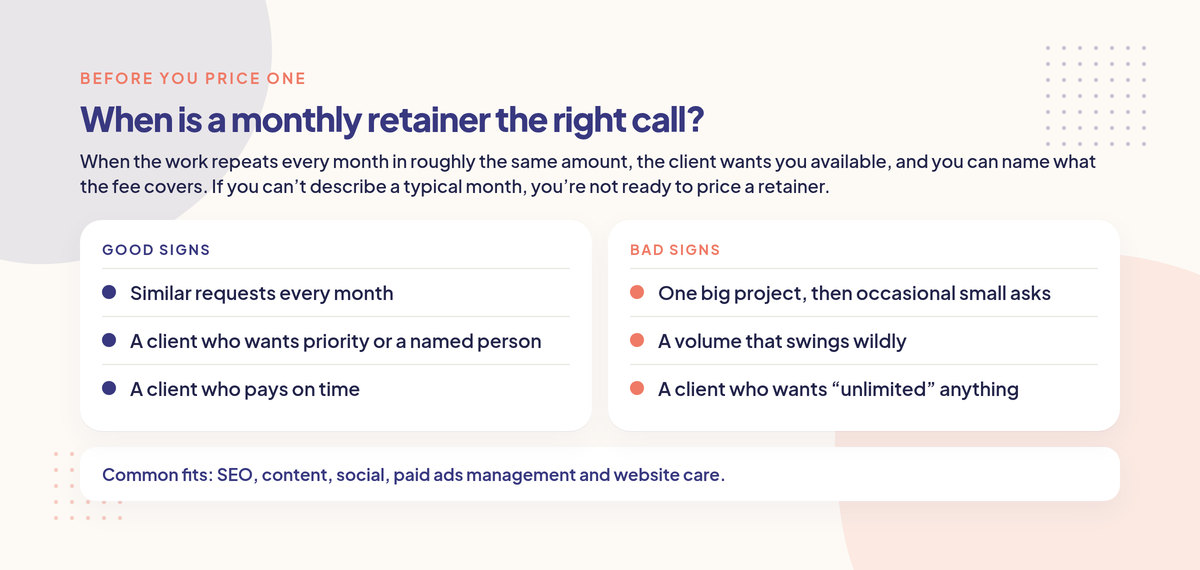
If you can't describe a typical month, you're not ready to price a retainer.
One r/freelance reply, in a thread about retainers vs a higher hourly rate, draws a useful line: a retainer that bills "a pre-defined number of hours" is tracked by hours, while a fixed monthly fee is "not based on hours, so scope must be defined." (For care plans, what's included in a website maintenance retainer has a ready list.)
What are the main agency retainer pricing models?
Agencies price retainers in five main ways: an hours bank (a block of hours each month), deliverables-based (a fixed list of outputs), tiered packages (two or three sizes of either), value-based or performance-linked fees, and hybrids that combine a fixed core with hourly extras. Each one defines "included" differently, so each one leaks in a different place.
It helps to know where bigger buyers are heading. The ANA's Trends in Agency Compensation study of client-side marketers reported in 2022 that labor-based fees were still the most common way ad agencies were paid, but that fixed or output-based fees were being used more often. These are big brands, not small agencies, but more clients want to pay for outputs, not hours.
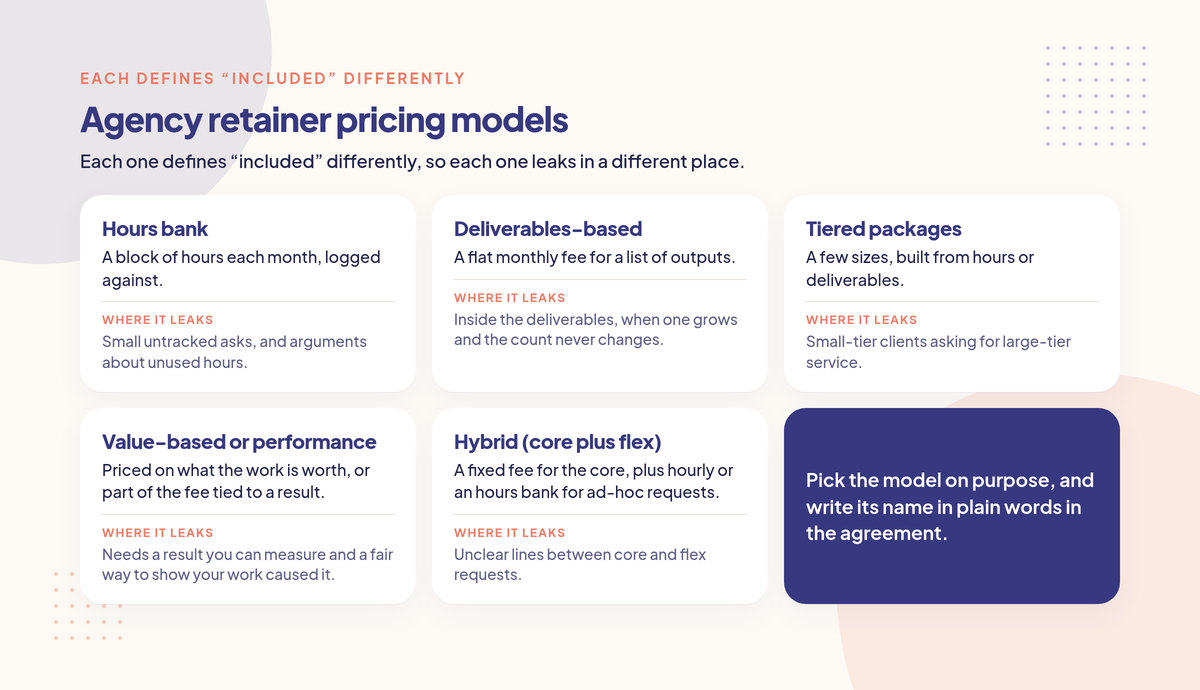
Each model defines "included" differently, so each leaks in a different place.
Hours bank retainer
The client buys a set number of hours each month, say 20, and you log work against them. It's easy to explain and flexible for the client, who can point the hours at whatever they need.
What counts as extra: anything past the monthly hours.
Where it leaks: small untracked asks, and arguments about unused hours.
What you need written down: the hours, how they're reported, the overage rate and the rollover rule. Should unused retainer hours roll over? compares the four common policies, and how to bill retainer overages covers the rate, the warning and the invoice line.
Deliverables-based retainer
The client pays a flat monthly fee for a list of outputs: four blog posts, one newsletter, a monthly report and a call. You don't report hours to the client, though you should still track them yourself.
What counts as extra: anything not on the list, or more of something than the list says.
Where it leaks: inside the deliverables. "A blog post" grows from 1,000 words to 3,000 words with original research, and the count never changes. Define each deliverable with a spec (length, revision rounds, what the client provides).
Why agencies like it: it rewards getting faster, and it's the model the ANA describes clients moving toward.
Revision rounds are where deliverables quietly double, so how to track client revision rounds matters most for this model.
Tiered retainers
Two or three packages, usually small, medium and large, built from either hours or deliverables. Tiers make the sales conversation easier, because the client picks a size instead of haggling over one number.
What counts as extra: anything in a higher tier that the client didn't buy.
Where it leaks: clients on the small tier asking for large-tier service ("can you also run our ads this month?"). The fix is writing each tier's exclusions as clearly as its inclusions.
Value-based and performance retainers
You price on what the work is worth to the client, or put part of the fee at risk against a result (leads, sales, rankings). It can pay the most, but it needs a result you can measure and a fair way to show your work caused it.
The ANA report is a caution here: most marketers said they "don't know" whether performance compensation was improving their agency's performance, and use of performance incentives had dropped to 41 percent from 48 percent in 2016. A safer version is a normal retainer plus a modest bonus for a target you both agree is measurable.
Hybrid (core plus flex)
A fixed fee for the core work every month, plus an hourly rate or an hours bank for ad-hoc requests. In an r/agency thread asking whether agencies bill per hour or per project, one reply described this as a "core/flex model": "Sell core services based on fixed outcome based price, and bill on hourly for scope creep."
How do you price an agency retainer fee?
Start from a realistic month of work, not a number you hope the client will accept. Estimate production hours, add time for meetings and account management, add a small buffer for minor asks, multiply by what an hour costs you, then add your margin. Check that the effective hourly rate is one you'd accept for hourly work.
Pick the model first. The model decides what the client is buying; the price follows.
Size a real month. For an existing client, use the last three months of actual hours, including the five-minute favours nobody logged. For a new client, list the deliverables and estimate each one honestly.
Add the time nobody lists. Calls, emails, reporting and project management. Leave it out and the retainer will feel underpaid by month two.
Add a small buffer for the minor asks that will happen anyway, so you can say yes to those and quote the rest.
Use your cost, then your margin. Work out what an hour of delivery costs you, then price for the margin you need. The retainer pricing calculator does this from deliverables, cost per hour and target margin, and shows three tiers from the same numbers.
Check the effective rate. Divide the fee by the hours you expect to spend. If it's well below your hourly rate, the retainer only works if the client uses less than they pay for.
Decide the overage rule now: an overage rate, a move to a bigger tier, or a separate quote. How to handle extra work on a retainer covers pricing those extras.
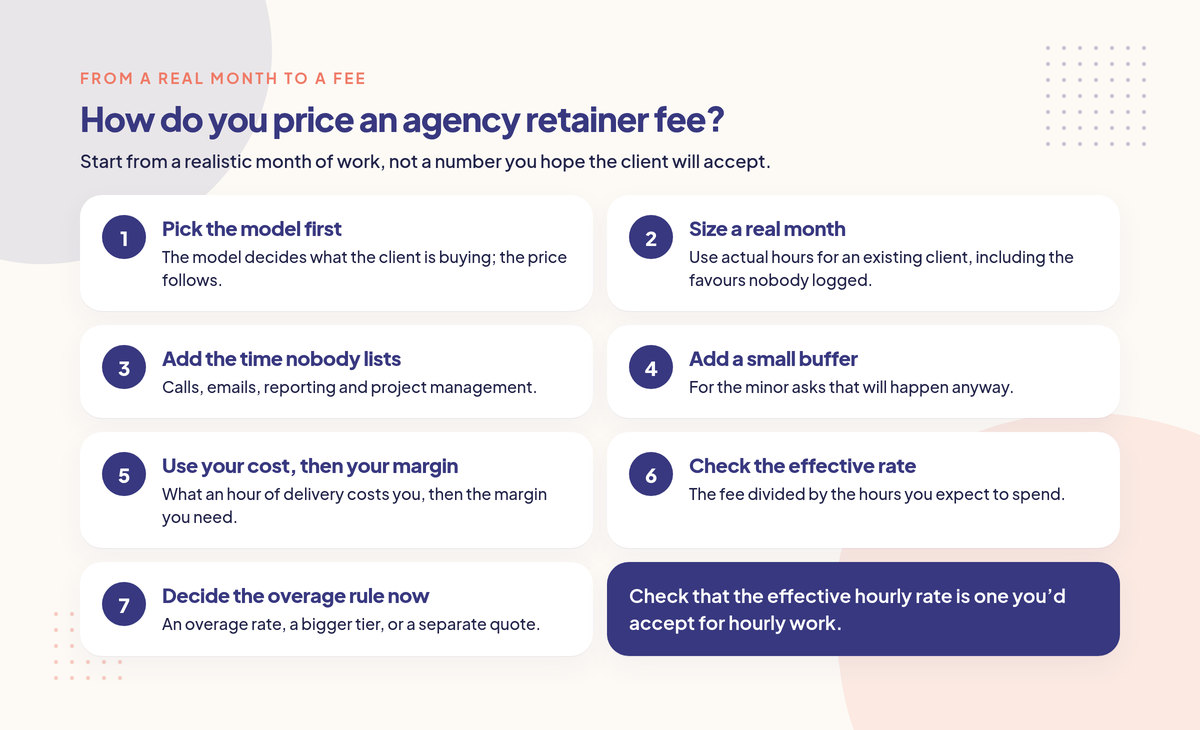
Start from a realistic month of work, not a number you hope the client will accept.
Should a retainer rate be lower than your hourly rate?
A little, sometimes, in return for a guaranteed commitment. One r/freelance reply in a thread on retainers vs hourly rates called "up to 10% for guaranteed work" fair, but only for a retainer of about six months or more. A month-to-month deal doesn't earn the same discount.
Example (hypothetical): one client priced three ways
The same client priced three ways, so you can see who comes out ahead in which month. The numbers are round and made up.
A small agency does content for one client: blog posts, a newsletter and a monthly report, about 20 hours a month. Standard rate: $100 an hour. Over three months the work takes 15, 25 and 20 hours, because month two includes a product launch.
Month 1 (15 h) | Month 2 (25 h) | Month 3 (20 h) | Quarter | |
|---|---|---|---|---|
Hourly at $100 | $1,500 | $2,500 | $2,000 | $6,000 |
Hours bank: 20 h for $1,800, overage $110/h | $1,800 | $1,800 + 5 × $110 = $2,350 | $1,800 | $5,950 |
Deliverables retainer: $2,000 flat | $2,000 | $2,000 | $2,000 | $6,000 |
What this shows:
Hourly paid exactly for the work, but the client got a $2,500 invoice in month two and probably asked why.
The hours bank gave the client a lower rate ($90 an hour inside the plan) and a predictable base. The agency got paid for the busy month through overage, as long as the client approved those five hours first.
The deliverables retainer sent the same invoice every month. The agency effectively earned about $133 an hour in month one and $80 in month two. If every month looks like month two, it's underpriced.
How does scope creep show up in each pricing model?
Scope creep happens under every model. It just looks different. On hourly it shows up as a bigger invoice the client resents. On a fixed price it shows up as hours you don't get paid for. On a retainer it shows up as small requests that each seem too minor to price, until the month is full. For the difference between unapproved growth and a priced, agreed change, see scope creep vs scope change.
So each model needs its own guard. Hourly needs a ceiling and regular reports. Fixed price needs a tight scope and a change process (scope creep clause has contract wording). An hours bank needs every request logged. A deliverables retainer needs each deliverable defined and a revision rule (how to charge for extra revisions). Tiers and hybrids need each tier's exclusions written down. When the extra does need a written offer, this guide covers what to include in a quote for additional work.
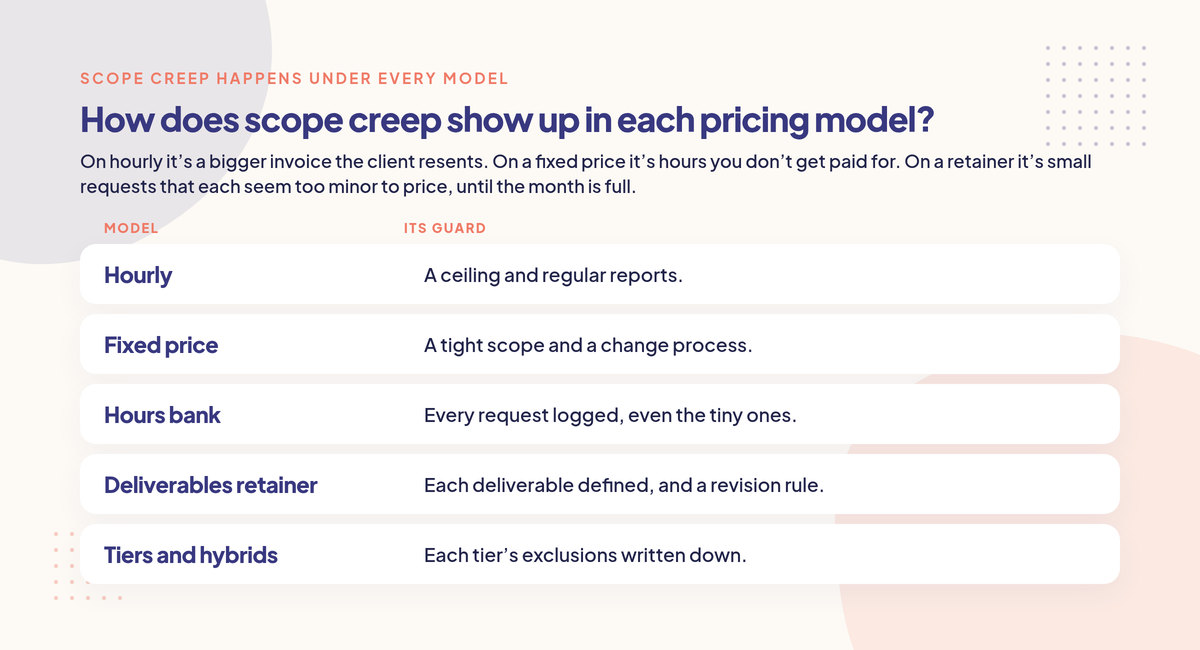
Scope creep happens under every model. It just looks different, so each model needs its own guard.
Either way, someone has to compare each new request with what the client pays for, before the work starts. You can do that by hand. If you'd rather not, there are scope creep tools built for it. Creepless is one: it checks each request against that client's included deliverables, excluded services, revision rounds and hour cap, marks it Included, Extra or Needs review, and turns extras into a quote the client approves from their private link before anyone starts.
To see what unpriced extras cost you now, the scope creep calculator puts a yearly number on unbilled hours.
When should you move a client from hourly to a retainer?
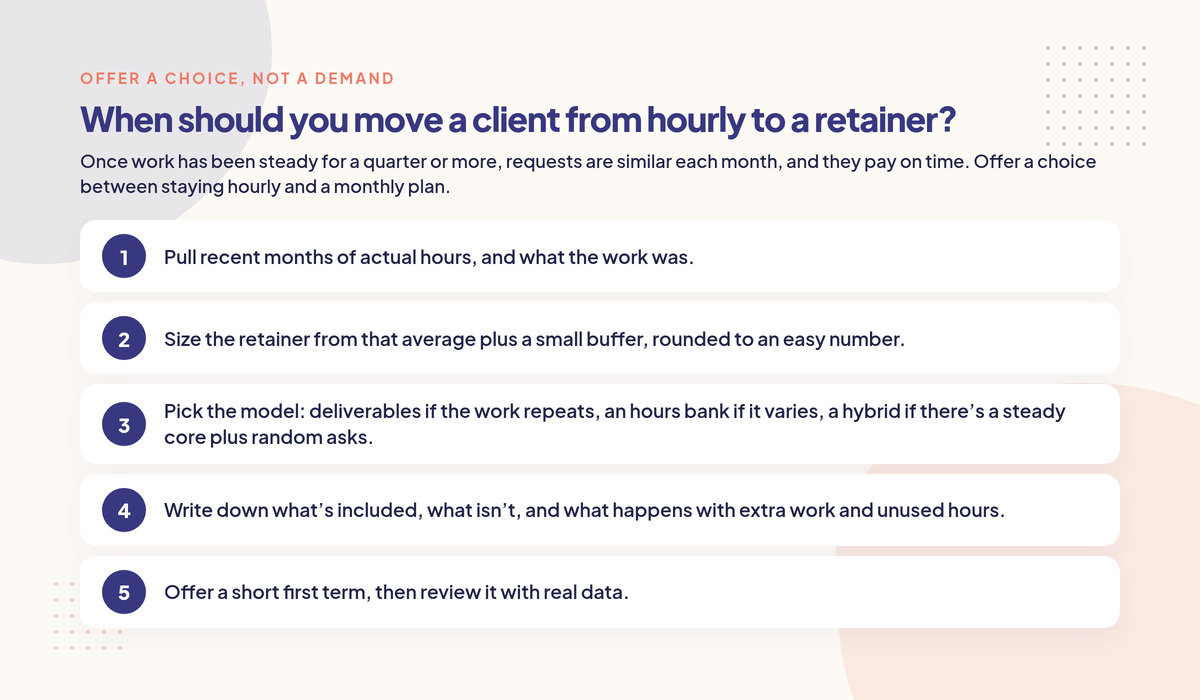
Move a client to a retainer once you've seen about three months of steady work, the requests are similar each month, and they pay on time. Offer it as a choice between staying hourly and a monthly plan, not as a demand.
The signals: work every month for a quarter or more, hours in a reasonable range, requests for quicker turnaround, and real time spent invoicing small amounts. Then:
Pull the last three months of actual hours and what the work was.
Size the retainer from that average plus a small buffer, rounded to an easy number. The retainer hours calculator does exactly this.
Pick the model: deliverables if the work repeats, an hours bank if it varies, a hybrid if there's a steady core plus random asks.
Write down what's included, what isn't, and what happens with extra work and unused hours.
Offer a short first term, such as three months, then review it with real data.
Offer it as a choice between staying hourly and a monthly plan, not as a demand.
What should the retainer agreement say about pricing?
The agreement should name the model, the fee, what's included and excluded, how extra work is approved and priced, what happens to unused hours, and the term. What should be included in a retainer agreement has the full checklist. Name the model in plain words, such as "a deliverables-based retainer; hours are not reported," so nobody argues about it six months later.
Hourly vs retainer FAQ
Is a retainer better than hourly?
Not always. A retainer is better for steady, recurring work where both sides want predictability. Hourly is better for unclear, occasional or first-time work, because the client pays for what's used and you don't absorb unknowns. A lot of agencies run both: hourly or fixed for projects, retainers for ongoing clients.
What is an agency retainer fee?
It's a fixed amount a client pays an agency every month, usually in advance, for an agreed amount of ongoing work. That work is defined as a block of hours, a list of deliverables, or both. Anything beyond it is billed separately under the agreement's rules.
What's the difference between a retainer and a flat fee?
People use the words loosely. Usually a retainer reserves capacity, often a set number of hours, each month. A flat fee pays for a defined result or a defined set of deliverables, with no hours reported. A "flat-fee retainer" is the deliverables-based model: same price monthly, scope defined by outputs.
Can you combine hourly and retainer billing?
Yes, and plenty of agencies do. The common version is a fixed monthly fee for core work plus an hourly rate for requests outside it, sometimes called core plus flex. It only works if the agreement says clearly which requests belong to the core and how hourly extras get approved.
The short version
Hourly puts the risk of extra work on the client, fixed price puts it on you, and a retainer splits it inside limits you write down. Charge hourly when the work is unclear or new, fixed when the result is clear, and move to a retainer once a client's work settles into a steady monthly pattern.
Pick the pricing model whose risk you can manage, and write the rules down before the first month starts.
When you pick a retainer, pick the model on purpose and size it from real hours with the retainer pricing calculator. Decide how extras, overages and unused hours work before the first month starts.
Creepless checks every client request against the scope you agreed.